

This article is the transcript of IRM India’s What’s The Risk?® episode telecast on CNBCTV18. The What’s The Risk?® initiative by IRM India Affiliate decodes risks and opportunities across diverse sectors with an objective of elevating the importance of risk intelligence and enterprise risk management as a skill, profession and business enabler.
Voiceover:
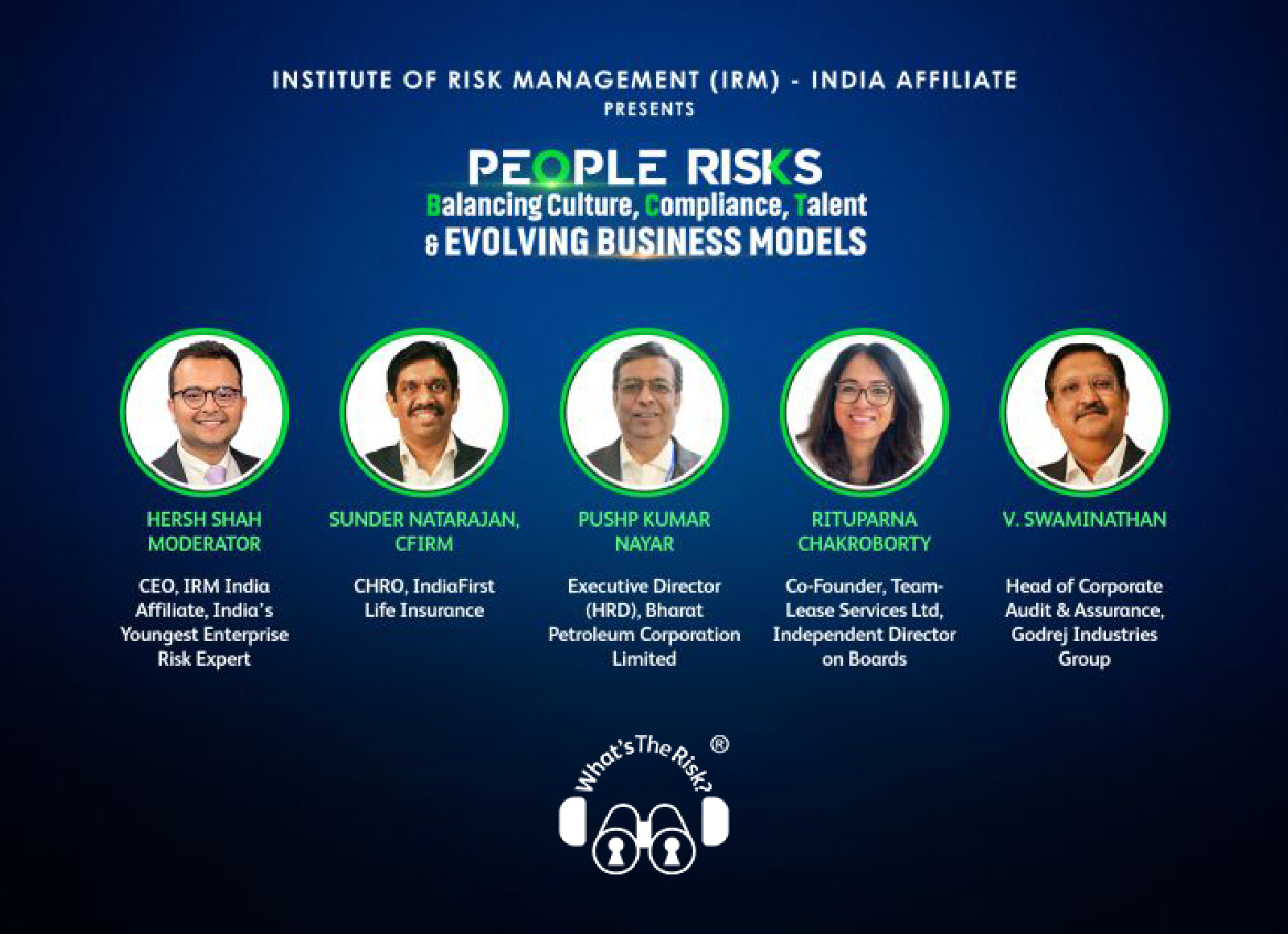
Institute of Risk Management India Affiliate presents People Risks – Balancing Culture, Compliance, Talent and Evolving Business Models.
Hersh Shah:
Imagine a key position in a company remains vacant for months because top candidates ghost midway through the recruitment process. Meanwhile, teams struggle as quiet quitting becomes rampant, with employees doing the bare minimum, leading to decreased productivity. Amongst this chaos, there’s gaslighting in workplace interactions where miscommunications start to erode trust and adding to this, side hustles are reshaping employee priorities with personal projects taking precedence over organisation goals. Now, these aren’t just buzzwords but clear indicators of the escalating people risks that organisations face today. In a world of rapid transformation, workforce dynamics have become a strategic concern. Hybrid work models are rewriting collaboration norms. The war for talent has intensified as organisations compete for top skills, and compliance requirements are growing more complex by the day. Trends like the great resignation, quiet hiring and the growing resurgence of boomerang employees reflect the evolving nature of workforce today. In this context, the intersection of risk aware cultures, strategic talent management, and innovative workforce solutions becomes critical for long-term resilience. So here’s welcoming all of you to the panel discussion on People Risks – Balancing Culture, Compliance, Talent and Evolving Business Models by the Institute of Risk Management India Affiliate. As the world’s leading certifying body for ERM exams across 140+ countries, the What’s The Risk?® initiative underscores our unwavering commitment to driving thought leadership in every sector and discipline. Joining me in the fifth episode are, V Swaminathan, Head of Corporate Audit & Assurance, Godrej Industries Group, Pushp Kumar Nayar, Executive Director (HRD), Bharat Petroleum Corporation Limited, Sunder Natarajan, CHRO, IndiaFirst Life Insurance, Rituparna Chakraborty, Co-Founder, TeamLease Services Limited, Independent Director on Boards. Lady and gentlemen, thank you for being a part of this insightful conversation. V Swaminathan (Head of Corporate Audit & Assurance, Godrej Industries Group), I actually want to start with you. You breathe audit, risk, assurance day in and day out. Tell us what a modern-day risk register for the HR function would look like and what are some of the most pressing people risks that organisations are facing today?
V Swaminathan:
Yeah. Organisations like ours at Godrej, the effort to mitigate these risks is through three prolonged strategies, in terms of leadership, in terms of processes, and in terms of technology. If you look at leadership, right from our chairperson getting directly involved in the talent identification and retention program, I see a group CHRO getting involved in the whole process of total talent management. The whole process around drawing policies, be it diversity, inclusion, involving all sets of people getting in the business process, giving them an equal opportunity to work, giving them a policy which encompasses all the employee needs, and to draw up a technology platform where you look at a 360 degree score, you look at an employee performance score and you draw up a complete score card for an employee to say how do I nurture this talent. That’s where the risk manifests itself.
Hersh Shah:
Sure, and if you can also touch upon the point on how this would impact the overall governance of organisations?
V Swaminathan:
So, organisations, as I said, always have a very aspirational goal. Now, if you don’t have the right set of talent who takes over, and therefore you’ll have to always build the backup plan. You always have to think in terms of if this critical employee is not available, who handles it and takes it forward. So, that puts a challenge in terms of availability of resources, the right mindset, the right talent and right delivery systems.
Hersh Shah:
Point well taken. Rituparna Chakraborty (Co-Founder, TeamLease Services Limited, Independent Director on Boards), I want to bring you in at this point. Since we touched upon governance, you sit on the boards of several companies. What is your perspective on how boards should look at people risk, especially in light of leadership and succession planning and culture transformation that Swami spoke about?
Rituparna Chakraborty:
So, as an independent director myself, I see boards increasingly acknowledging talent risk as central to organisational resilience. However, many boards, unfortunately, still operate reactively rather than proactively on issues like leadership succession and also cultural transformation. Now, to enhance effectiveness, I mean what I feel could be some of the recommended strategies would be, number one, I think it’s very important to ensure that talent per se is embedded or a talent risk is embedded into ERM frameworks. Boards should and must integrate talent risk such as leadership gaps, skill shortages, and cultural misalignment into the Enterprise Risk Management framework. I think what it does essentially is, it allows systematic monitoring, much like we do with financial or operational risk, which the board spends enough time today reviewing, but not as much probably on the talent side. These are some of my thoughts. These are a few steps, which I think proactively if boards start emphasizing and weighing down, we would go a long way in terms of mitigating a lot of risks which we see around us and it would unlock a lot of other opportunities.
Hersh Shah:
You know, there was a study on the amount of time spent by boards on risk related discussions and that’s 20 to 33% of the time spent focuses on risk registers, risk management committee, risk related strategies and of course, talent fits in that. So, are you saying the time allocation for these discussions should go up? Where are we in this scenario today?
Rituparna Chakraborty:
Absolutely. I think, while now more or less especially listed organisations do have a mandate in terms of having a Nomination and Remuneration Committee (NRC), and most organisations have an NRC committee, at least the listed ones, but I think the time allocation is disproportionate. We must acknowledge it before we do something about it. I think progressive organisations are focusing and are accepting talent as a challenge, and the board is accepting and spending time, but it’s not something that I can tell you is unilateral. So yes, you can solve a lot of problems on the financial side, there are very binary answers, honestly, to solve problems on the financial side, operational side, legal side, but when it comes to talent, the answers are not usually binary and that’s why it needs more time from boards and organisations, and needs more time allocations and discussions and debates.
Hersh Shah:
Alright, Pushp Kumar Nayar (Executive Director (HRD), Bharat Petroleum Corporation Limited), coming to you. What are some of the HR-related compliance risks that you are seeing today, and as a PSU, how are you adapting to the changing business models?
Pushp Kumar Nayar:
So, let me take compliance first. I think, for compliance risks we have to understand whether we are really going with it as a mandate or are we seeking some larger purpose behind those compliances, because those compliances are really required to sustain the business growth and for the overall society that you’re living in. Once the purpose is clear, I think those risks can be managed very easily and to some extent there’s a lot of enrolment required from the people who are going to be managing those risks and with the senior leadership. Those risk talks have to be done to enrol everybody and also I think technology should be used so that you free up the mundane activities and let people focus on value creation jobs. In those situations, I think compliances will become easier to manage. I’m from Bharat Petroleum, so for energy companies, the landscape is changing very fast. Lots of discussions around climate change, around new technologies which are emerging, but yet India is growing, so our core growth is happening through traditional fuels. So, while we are focusing on traditional fuels, we are having some big bets on new areas like petrochemicals, gas, etc. I think technology will play a very big role in our journey for taking care of the business environment, and it’s not typical HR hygiene, SAP, or other things, but using AI for HR analytics, and for HR decisions. We have started taking those steps, and they are the ones which will make a lot of difference.
Hersh Shah:
That’s commendable, and are you seeing that across the PSU segment, or is that only for BPC?
Pushp Kumar Nayar:
I would say everybody has started taking baby steps. I wouldn’t say that we have really grown very far, but those steps have started.
Hersh Shah:
Sunder Natarajan (CHRO, IndiaFirst Life Insurance), finally, coming to you before we take a short break. You’ve been the Chief Risk Officer of IndiaFirst Life Insurance, now the CHRO, and you’re also a qualified fellow in Enterprise Risk from IRM. What are some of the metrics or KPI’s that organisations should use to assess people risk strategies, because people risk management is often very intangible, it becomes difficult to measure, so if you can throw some light on that?
Sunder Natarajan:
Sure. A great effort by the regulator and regulation which has been made in this direction is to measure various elements of ESG, and as you would know, the S portion of it is typically underplayed, but this gives a lot of teeth to a lot of organisations. Any employee who is happy in the first 6 months of joining an organisation ends up being a very, very productive employee. So, such lead indicators today are available through use of technology, and if these are measured and these are acted upon, we get a good perspective of where we are going. Let’s look at another dimension of what impacts an employee, it is typically mental and physical well-being. A lot of organisations today take help from external organisations to offer toll-free helplines to help and to get mental health counselling. How many such calls are made? So, these are confidential, but how many such calls are made? Those give a good indicator. How many accidents happen in an organisation? How many accidents are employees exposed to, let’s say, on the road when they are out, let’s say, selling? These can be easily measured, and are measured through accident covers, and what kind of spends are organisations doing to protect their employees. Today, we are moving ahead and looking at measurement metrics across the lifespan of the employee.
Hersh Shah:
So, there’s enough data points available for you to conclude whether there are mitigation strategies working towards managing people related risks.
Sunder Natarajan:
Data points were always available. Today, we are measuring those data points, and we are acting on those. I think that’s making a big difference.
Hersh Shah:
Well, it’s time for a quick break, but we’ll return shortly with our esteemed panel to continue discussions on navigating the complexities of people risks and shaping resilient organisations.
Voiceover:
Institute of Risk Management India Affiliate presents People Risks – Balancing Culture, Compliance, Talent and Evolving Business Models.
Hersh Shah:
Welcome back to the fifth episode of IRM India’s What’s the Risk?® initiative, People Risks – Balancing Culture, Compliance, Talent and Evolving Business Models. I’ve been in conversation with V Swaminathan, Sunder, Pushp and Rituparna. Ritu, we are in a country where there seems to be a surplus of talent, and the challenge for organisations actually lies in identifying the right people, as they all said, especially aligning with the company goals and culture. So, how do you see recruitment services firms helping organisations navigate this problem of plenty and also meet the demand for niche skill sets?
Rituparna Chakraborty:
So, the challenge in a talent rich and sometimes employability poor country like India isn’t about finding people but always about finding the right people, as has already been spoken in the panel today. This involves, honestly, aligning skills, values and aspirations with an organisation’s goals and culture. So, the three things essentially are three areas where I feel maximum collaboration is possible, one of course is data-driven talent mapping. I think firms today who are honestly ahead of the pack, now leverage AI and predictive analytics to map not just available talent but potential career trajectories, cultural fit, which we’ve already spoken about, as well as adaptability. The second aspect, of course, is building specialised talent pools. I think recruitment services companies proactively create a pipeline of such niche skilled professionals through talent community building, very specific and targeted upskilling initiatives, and partnerships with various educational institutions. The third, of course, is addressing attrition risk. Attrition, we all know, is particularly high in sectors like BFSI, and historically has been with IT. Of course, it’s a little managed today because of the current environment, but it’s a challenge. So, recruitment firms actually help organisations preemptively tackle this by designing stay interviews, monitoring market sentiments, and benchmarking industry retention rates across the board. As a matter of fact, one of India’s leading IT firms happened to reduce their attrition by 12% to target their retention strategies, which they designed together with one of these recruitment firms based on exit data analysis. So, these are some of the ways in which I think organisations can work together with these recruitment services to kind of evolve a strategy for the future.
Hersh Shah:
And Ritu, since we’ve spoken about technology, and bots, and AI, have you ever come across a platform like a dating app where the employer and the employee are on a similar platform, or a device, or an app, and they’re actually swiping to see if the skill set, culture, and goals align? Maybe I’m giving away a business idea.
Rituparna Chakraborty:
No, I think you’re bang on. As a matter of fact, as you speak, there are different collaborations which are going on between organisations, some of the leading management schools in India, as well as some of the Ivy League colleges, where they’re using the dating app algorithm to see if there is a faster, quicker, more intelligent way in terms of hiring the right kind of talent. It’s already getting used quite actively in the gig hiring space, especially when you’re looking at specialised gig workers and specialised skill sets. So honestly, what you think is the future may be already here.
Hersh Shah:
Need for speed, as they call it. Pushp, coming to you on attrition because she spoke about attrition, in the PSU sector actually, workforce stability becomes a critical point. So, how are you looking at managing employee morale, mental health, wellness and other kinds of risks?
Pushp Kumar Nayar:
I mean, it’s not those eras when people will join PSUs for only stability. Maybe they’ll join, but today the opportunities are too many, so they’ll not stay unless they get two to three big things. They are definitely looking at career development, career growth, a career path which leads to their development, that’s one. The second big thing is that they’re looking for leadership in the company – What is the vision? What is the company culture? What are the values that the company is demonstrating? Those are two very big things, and third, let’s also give this advantage to PSU’s that when you are really doing those things, you are contributing to nation building. So, those three are the key motivators which will let employees stay within the PSU framework, and today we are working if not better, at least equal to MNC’s and those things are there. What we have realised is that, as part of the entire framework, we are really working very well on an integrated career development framework where we have on one side, the organisation, and on the other, the employee. Have inputs from both as well as look at goals for both. So, every employee knows that he will have a place on the table and there are seniors who are looking at each profile. He is being given the opportunity to put his aspiration. We are building the capability of line managers, we are also allowing them to participate in the whole process, so that’s one. The other part which you mentioned is about the experience of the individual, about how they feel aligned, about their overall well-being. So, we are giving them a variety of experiences which will help them enjoy their total life, not only work life.
Hersh Shah:
Sunder, we’ve seen a rise of remote staff and also off-payroll contractors, gig workers, as Ritu mentioned. In light of the technological advancement with AI, data security, the new DPDP Act as well. How are you seeing these risks play within the overall people risk framework?
Sunder Natarajan:
As you would know, any regulation is risk management at the country level right, so which is, I would say, done fairly adequately as of now, and it is future-oriented. Now, the next comes how are organisations, individual organisations approaching this phenomenon. Individual organisations are looking at it from the entry to exit stage of the employee, and also of the contract employee, and also of any vendors they would on-board and exit. So, there is a pre-screening done today, and there are also vendor reviews which are done at a renewal stage because at the renewal, we don’t know what’s the stage of the vendor. Companies today are steering towards good governance, good governance is being given a lot of importance not only at the board level but also at the management and the operational levels.
Hersh Shah:
Are you sure it’s just not ticking the box, and people are actually taking this seriously, either through education programmes or more awareness at the ground, because these kind of risks around cyber attacks or cyber security is also driven by the person, if he or she is not aware, that can put the entire organisation at risk.
Sunder Natarajan:
Yes and no. Yes, because there is a protocol which is put in place. So, in an organisation, it is extremely important for every individual to be self-aware, and organisations today are not only making the environment idiot-proof but also are educating employees so that they contribute towards it. So, it is a two-way exercise, and I think there is a lot of good progress which is happening around this.
Hersh Shah:
Alright. Swami, finally, coming to you. You’re a risk expert, and the micro, small, medium enterprises actually can’t afford having a Chief Risk Officer or having large investments in people risk management strategies. What would be your advice in terms of some of the best practices that they can adopt based on large companies like yours?
V Swaminathan:
In contrast, if you look at MSME, which is the point that you’re raising, MSME, largely seen, MSME organisations where a single owner runs the whole operation, he or she is the brain behind the whole venture and the success that he or she has brought about. Now, how do you scale it up, that’s where the challenge comes in, for which the only sure shot in this risk mitigation process is, they will have to develop trust in their second line, develop them to take charge, empower them to make sure that they take the right decisions, support them when they falter, and then grow and scale it up. When we deal with these kind of MSME organisations, we’ve always brought this perspective to them because our dependence on some of these MSME’s as third party risks are equally there. So, the larger organisations must keep sharing the learnings with these MSME’s and help them grow.
Hersh Shah:
Well, on that note, thank you to our panellists for providing their invaluable insights and diverse perspectives. Organisations must also leverage data-driven insights to navigate uncertainties, creating adaptive teams ready to address complex scenarios by prioritising these efforts, and businesses can enhance resilience to drive sustainable growth within the HR function. Thank you for joining us, and stay tuned for the next episode of What’s the Risk?®.
Voiceover:
Institute of Risk Management India Affiliate presents People Risks – Balancing Culture, Compliance, Talent and Evolving Business Models.