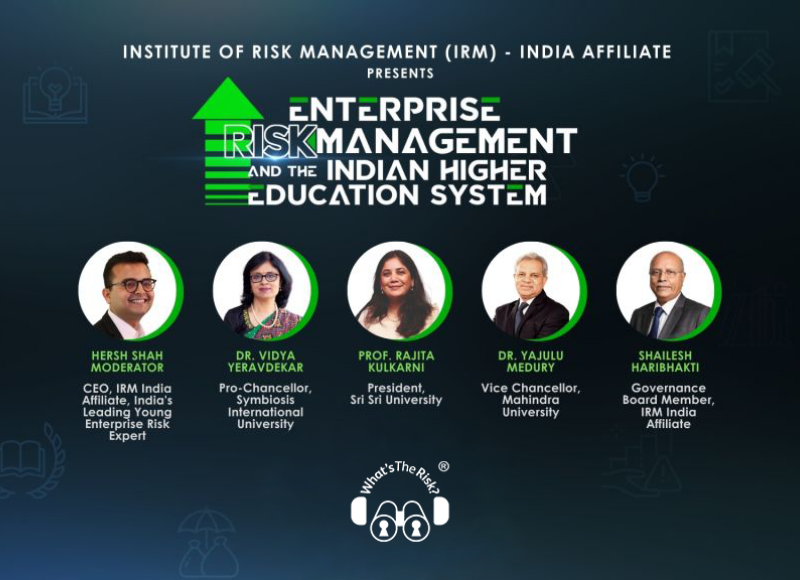


This article is the transcript of IRM India’s What’s The Risk® episode telecast on CNBCTV18. The What’s The Risk® initiative by IRM India Affiliate decodes risks and opportunities across diverse sectors with an objective of elevating the importance of risk intelligence and enterprise risk management as a skill, profession and business enabler.
Voiceover:
Institute of Risk Management India Affiliate presents Enterprise Risk Management and the Indian Higher Education System.
Hersh Shah:
Education is the passport to the future, for tomorrow belongs to those who prepare for it today. Drawing from Malcolm X’s insightful recognition of education as a transformative force and with 1,100 universities, 12,000 standalone institutions, 45,000 colleges and over 43.3 million enrollments, India’s higher education system is uniquely positioned to create world history on the five guiding pillars of Access, Equity, Quality, Affordability and Accountability under the National Education Policy. As a powerhouse for global talent, our institutions have the potential to cultivate a robust ecosystem that prioritises sustainability, research, skill-based education and technological innovation, thereby setting benchmarks and enhancing India’s footprint on the global educational stage. Yet, as the adage goes, where there are opportunities, risks are never far behind. So, whether it’s soaring operational costs, external crises like pandemics or wars, changing regulations, shifting student preferences, or even cybersecurity threats, this sector is equally susceptible to a myriad of challenges. In this context, here’s welcoming all of you to this panel discussion on Enterprise Risk Management and the Indian Higher Education System by the Institute of Risk Management India Affiliate. As the world’s leading certifying body in ERM exams across 140 countries, the What’s the Risk® initiative underscores our unwavering commitment to driving thought leadership in every sector and discipline. Let me introduce our distinguished panelists for this second episode – Professor Rajita Kulkarni, President, Sri Sri University, Mr. Shailesh Haribhakti, Governance Board Member at IRM India and Independent Director on several company boards, Dr. Vidya Yeravdekar, Pro-Chancellor, Symbiosis International University, and Dr. Yajulu Medury, Vice-Chancellor, Mahindra University. Ladies and gentlemen, thank you very much for joining me today. Dr. Vidya Yeravdekar (Pro-Chancellor, Symbiosis International University), I want to start with you. First, congratulations on your new campus in Dubai. Now, with Symbiosis operating multiple campuses across the country, your university is no less than a conglomerate. So, in your view, what are some of the current and emerging risks that education institutions are most vulnerable to, and have you integrated risk management into the strategic planning and operations of your university?
Dr. Vidya Yeravdekar:
Look at what Symbiosis is. 45,000 students from all states of India, from 85 different countries, more than 6,000 – 7,000 staff members. Imagine the kind of risks and the management of risk that we should have thought of but honestly, there wasn’t even a risk management policy till we decided to set up our campus in Dubai, and it so happened that when we decided to set up the campus in Dubai and go through the CA accreditation under their Ministry of Education, that’s when they told us that you need to write a policy on risk management and that actually set us up thinking about a risk management strategy for the University. Thanks to you, of course, Hersh. You’ve been telling me this for several months now, and we’re teaching our students, but not creating a document for ourselves. So, I think, academic institutions like other enterprises are vulnerable to risks. In fact, our stakeholders are the young population, a very vulnerable population, and you know, there are different kinds of risks that universities would actually undergo. One of course is strategic risk. When we decide to start, for example a campus in Dubai, or a Hyderabad, or Bangalore, many times it’s intuitive, we really don’t do as much of risk analysis before we actually go and set up something in Bangalore, or Hyderabad, or wherever we want to expand. The second is Financial Risk. You know, especially in institutions like ours, and Rajita’s, and others where these are self-finance institutions, we really need to take care of our own finances, and the only source is tuition fees, that’s such a huge risk that we take, but have we really done something to create a management policy towards this kind of risk. And then of course, health and safety risks, operational risks. So, several kinds of risks. I feel that universities are like large conglomerates as you very rightly said, and we need to define, and I think, the University Grants Commission should also have a regulation coming up with an Enterprise Risk Management regulation, or something that will help Indian universities to frame their own policies depending on the nature of their operations.
Hersh Shah:
Dr. Yajulu Medury (Vice-Chancellor, Mahindra University), at this point, I’d like to bring you in. Mahindra University is home to some of the exceptional schools, and in all our interactions you’ve always told me that technology is at the core of everything you do. Considering the rapid change in technology, how are you seeing the evolution of cyber threats? Is Mahindra University really strengthening its cyber security framework? Tell us some of the best practices that would benefit the education ecosystem.
Dr. Yajulu Medury:
You know, the words which you have said, Cybersecurity and Data Privacy, these are all absolute words which you look at nowadays. We at Mahindra University, fairly new, are part of the Microsoft Academic Alliance Network, and being an Academic Alliance partner, we extensively make use of the Microsoft cloud services for all our admin and faculty teaching activities. The faculty uses regular aspects such as Office 365, Teams, One Drive folder for day-to-day communication needs between various stakeholders in the organization. So, these tools actually provide granular controls from the perspective of information access management, to ensure that all stakeholders are allowed access to data only on a strictly need-to-know and right-to-know basis. Further, we also update our access controls by incorporating latest cloud security features released by Microsoft Cloud, such as use of the two factor authentication wherever possible. Finally, cloud logs are continuously monitored to check for any malicious activity, either by inside or outside threats. The underlying network infrastructure itself is protected from unauthorized access by using network access control tools such as, Aruba clearpass policy etc. In the next five years, at Mahindra University, we’re going to ramp up our student strength from the existing 5,000 to around 10,000 students. Which means that we will need enhanced security to protect advanced research which our faculty will do, students will do, etc. So, we’re planning to establish the network and security operational centres by establishing the NOC and the SOC as they’re called. We would achieve all the 8 security principles laid out in the Information Assurance Standards of the Government of India, and recommended by most reputed cyber security agencies, such as NIST and ISACA. I think this would sort of underlie what we are trying to do over the next 3 to 5 years.
Hersh Shah:
Great. Professor Rajita Kulkarni (President, Sri Sri University), I’d like to come to you at this point. You’ve weaved in The Art of Living curriculum into the Sri Sri University ecosystem very well, and mental health is one of the critical risks that organisations and institutions are facing. Can you share some best practices for other universities to mitigate the risk of mental health which will really enhance well-being of not just students but also the faculty members?
Professor Rajita Kulkarni:
Focusing on personal well-being holistically, so, mental, emotional, physical, and also spiritual. The Art of Living Program, Yoga, Meditation, Sudarshan Kriya is a way of life, all our students learn it as a part of the induction. There are even credits for that. We have created an ecosystem where students have the access to, and the freedom to practice it at their ease, and what we have seen is that this has an impact on not only a general sense of well-being, but it has a very deep impact on your ability to focus, it improves the alpha and beta, both waves in the brain. So, it makes you relaxed, as well as alert. Inability to focus is a big risk today. If you see the data, they say that students especially are focusing not more than 10 to 15 seconds at a time. So, this develops focus, it develops a creative intuitive ability, improves their collaborative skills, creative skills, we have seen that helping students in a big way. The second thing, which I think belonging to The Art of Living DNA, we have integrated in our way of life, is the intent and the ability to serve the community. Seva, as we say in India, is a way of life on our campus, and that Hersh, we have seen, has had a very big impact. The Gen Z we read so much about it, we have seen that just being in the community, we have about 70-80 villages in our neighborhood, which we have kind of associated with and adopted in a way, so just going and doing some hygiene camps, or even little education camps for children, or agriculture advocacy camps, or many other such activities. It develops confidence, it develops collaborative skills, we have seen, it enhances a sense of contentment. Today, one of the big risks of this generation is, we are creating a 10-minute generation, where everything is available in 10 minutes, and if you don’t get it fast then you become so unhappy and discontented. We have seen, it improves that contentment, it improves a sense of compassion towards themselves and others. So, this has also shown us very good results. Of course, so many other things which are quite common on education campuses, focusing on physical well-being, sports activities, so we are seeing the interconnected sort of benefits of it, not just for students, but also overall from an institutional point of view.
Hersh Shah:
Mr. Shailesh Haribhakti (Governance Board Member, IRM India Affiliate), you sit on the boards of several large listed companies. What would be your advice on the right governance and risk structure that Indian higher education institutions should adopt?
Shailesh Haribhakti:
What governance does is, it creates a principle-based environment around making sure that things work as they are meant to work. It is supportive of the outcomes, it is supportive of all the economic interests, and in a university, the economic interests are those of the parents, the students, the teachers, the learning outcomes, the future recruiters, all of their interests need to be brought together, in a manner that the outcome will be such that the country can go forward with the challenges that we are today facing. Every day new opportunities are springing up, just take the way artificial intelligence has galloped, the pace at which capabilities are going up. When you see that intersecting with things like decarbonization, and the need to make sure that we as the human race can continue to exist, then all the lessons of sustainability, technology, spirituality, all of these that we talk about need to get incorporated into the educational institutions’ governance mechanisms and risk management.
Hersh Shah:
The SEBI’s LODR guidelines, or, if you see the RBI mandates on risk management, do you think the Indian education regulator needs to mandate the appointment of a Chief Risk Officer (CRO) or a dedicated risk function that proactively identifies or manages risk, just like Dr. Vidya mentioned?
Shailesh Haribhakti:
Absolutely, I think it is high time that this happens. SEBI took a fantastic step by saying that there must be a risk management committee, and it must have one independent director as a member of that committee. I think that’s a very wonderful leading practice that all regulators can learn from, and I would encourage the education regulator to take the lead in mandating the appointment of a Chief Risk Officer, because as Professor Vidya mentioned, as you go Global, and as you want to make sure that you are in line with the best practices in the world, it’s better to lead them, and what better way to lead it than to have a Chief Risk Officer.
Hersh Shah:
No, definitely. I take your point that weaving risk management into the fabric of the higher education institution is a must. In fact, many US and UK universities have a dedicated risk function, or they’ve started getting a CRO on board who actually reports to the trustees or the governing board. Alright, it’s time for a quick break, but we’ll be back with this wonderful panel to discuss India’s leadership within the global South and the evolving role of risk intelligence as a critical skill in today’s world. Be back in a minute.
Voiceover:
Institute of Risk Management India Affiliate presents Enterprise Risk Management and the Indian Higher Education System.
Hersh Shah:
Welcome back to the second episode of IRM India’s What’s the Risk initiative, Enterprise Risk Management and the Indian Higher Education System. I have been in conversation with Professor Rajita, Mr. Haribhakti, Dr. Vidya, and Dr. Yajulu. Thank you, ladies and gentlemen, for your patience. Dr. Vidya, you’ve been a firm believer that India can really lead the way in building a sustainable higher education ecosystem in the global South. So, how do you think our institutions’ students, faculty members and even academic leaders can actually become messiahs to some of the biggest problems faced by global South countries?
Dr. Vidya Yeravdekar:
Yes, Hersh, I’ve always been promoting that India needs to be a leader of the global South, and I’ve been doing this for several years now, in my endeavor and my research in the area of internationalization of higher education. If you look at the past, the number of foreign students who came to India to study, primarily from Afro-Asian countries, and within Afro-Asian countries, primarily from Africa. If you look at countries of East Africa, whether it’s Ethiopia, Tanzania, Kenya, Uganda, Mozambique, all these countries have several alumni who passed out of Indian institutions and are doing so well. In fact, some of the heads of states of those countries have been students of Indian universities, and therefore we’ve educated Africa, and today if you look at it, the world knows that it’s the youngest and the most aspirational population of the world. Here, India and more specifically Indian higher education, can play a major role. It’s one, building capacity in the youth of the global South, which we have been doing for several years, and we should continue to do, but more importantly, even looking at problems in the global South and finding solutions. I think there are such similar problems, whether it’s problems of poverty, waste management, several problems, even risk management for that matter. In several areas, we would be facing the same problems. So, it has been our endeavor now for some years, that we are also connecting with African Academia, Hersh, because when we looked at doing joint research, it was always with the North. We looked at faculty from America, faculty from Europe, who would come and find solutions to problems here in India. We decided to turn it around, and said that, if we have common problems, can Academia from both these areas or regions come together? Can Indian and African Academia come together to do joint research and find solutions to common problems in our regions, in our countries? And that has really helped a lot. We’ve come much closer, and I think, not just Symbiosis International University which is way ahead in internationalization, but, Indian higher education system should be one of the front-runners, leaders for the global South.
Hersh Shah:
I want to ask you, specifically around students. What are the challenges that they are seeing in today’s external environment, or even on campus? Can you highlight some of the risks, and also, what do you think is the role of an educator to help these students manage these risks better, beyond the mental health program that you spoke about?
Professor Rajita Kulkarni:
Skill obsolescence is an important risk and a challenge that we are seeing. Climate change has reached our doorstep. I think, it was a theoretical concept for people some time back, but today, it is a reality. Natural resource depletion is a reality. By the vision of Pujya Gurudev Sri Sri Ravi Shankarji, set up a centre of excellence on water restoration and climate change, and in India, Art of Living has restored and revived about 77 Rivers. So, to identify it as a risk and to ensure that we are doing something to resolve it is also our approach. So, second is climate change. The third, I think, is Digital Risk. We are living in a digital world, cyber bullying, Hersh, is a reality today, our students are experiencing it. Cyber wars, being influenced by the not so essentials of life and making that a reality. This YOLO approach to life is making some of the younger generations go into directions which are not healthy, so, this is a big risk. In fact, we’ve set up a centre of excellence, we are told one of the first in the world, on cyber peace, so, the whole Digital Risk. The good thing is that, more and more we talk about it, more and more we are able to come up with ways and means to help our students deal with it.
Hersh Shah:
I want to come to Dr. Yajulu. Mahindra University has been one of the first institutions in India to integrate IRM’s Global Enterprise Risk Exams into the curriculum, in line with NEP. With the increasing need for global life skills, what is your vision in terms of developing a risk-intelligent talent? And, how do you think we should equip India’s youth with all the risk knowledge that Professor Rajita mentioned?
Dr. Yajulu Medury:
How do we foster a culture of risk intelligence and equip our students with comprehensive risk knowledge to navigate the complexities of an ever evolving world? Look at it in the light of global challenges, where we have conflicts between countries, misinformation crisis, the recent pandemic, deepfake videos etc. Our vision should be to empower students to become resilient, proactive, and ethically driven leaders capable of addressing the multifaceted risks facing society. So, what are we doing? We can envision a university where, as you have said, risk management is integrated seamlessly into our curriculum, ensuring that every student graduates with a deep understanding of risk principles, and practical skills to identify, assess and mitigate potential threats. Education has to be interdisciplinary, experiential learning, global perspectives, this is how we can aim to cultivate a new generation of leaders and students who are not only adept at managing risks within their respective fields, but also capable of collaborating across disciplines and borders to tackle complex challenges collaboratively. I think all of us together, Educators in India and overseas, we can strive to shape a future where India’s youth are equipped with such knowledge, skills, and mindset necessary. I have to add today, Hersh, it’s very pertinent to add, that along with IRM we will be setting up the Centre for ERM, which will be the only one in the South Region to boost risk intelligence and resilience for years to come, and we’re also delighted at all the scholarships that you keep offering to a faculty, who then get trained and then they’re able to pass on the training to students and other faculty. So, thank you, thank you very much, Hersh.
Hersh Shah:
Well, I must even compliment Professor Rajita and Dr. Vidya on that, because, we’re looking at a Centre for Risk in East India with Sri Sri University, and Symbiosis is for West India. On a concluding note, Shailesh Bhai, you’ve spoken about decarbonization, artificial intelligence, ethical leadership, like Dr. Yajulu mentioned. How do you see the role of Risk Professionals in driving this change? They’re really going to be the guardians of society, so, what is your take on this?
Shailesh Haribhakti:
It’s such an exciting future, and what IRM is doing, in terms of making people ready for this exciting future, is something that the whole of industry and the whole of educational institutions can learn from, can derive benefit from. I’m so happy to hear that all the universities that we are interacting with on this panel, are all taking this so seriously, to have a centre in each of these three universities is spectacular. So, to my mind, risk will become far better recognised, far better managed, so, let’s look at how this will be done. It’s critical to create a repository of things that have gone wrong, and then test using machine learning algorithms, everything that is happening today. If you can then discern patterns, then you’ll be able to predict where the risk is going to come from.
Hersh Shah:
So, culture of no surprises.
Shailesh Haribhakti:
No surprises. It has to become predictable, prevented, self-healing, and back on a path of ascendency. Now that is what a risk professional will deliver, if they are part and parcel of a team at a university, and I must compliment all three of you for establishing these centres, it will be spectacular for India and for your universities.
Hersh Shah:
Well, on that note, thank you, distinguished panelists for sharing your expertise and unique perspectives. I hope our conversation today actually accelerates the integration of Enterprise Risk Management in the Indian Higher Education system, with more leaders using it as a strategic compass, not to just protect legacy, drive good governance, and enhance preparedness, or rather resilience, but also, develop certified risk intelligent graduates, like they said, who are equipped to tackle the world’s most complex challenges with wisdom, ethical integrity, and innovation. Thank you, once again, and stay tuned for our next What’s The Risk episode.
Voiceover:
Institute of Risk Management India Affiliate presents Enterprise Risk Management and the Indian Higher Education System.