
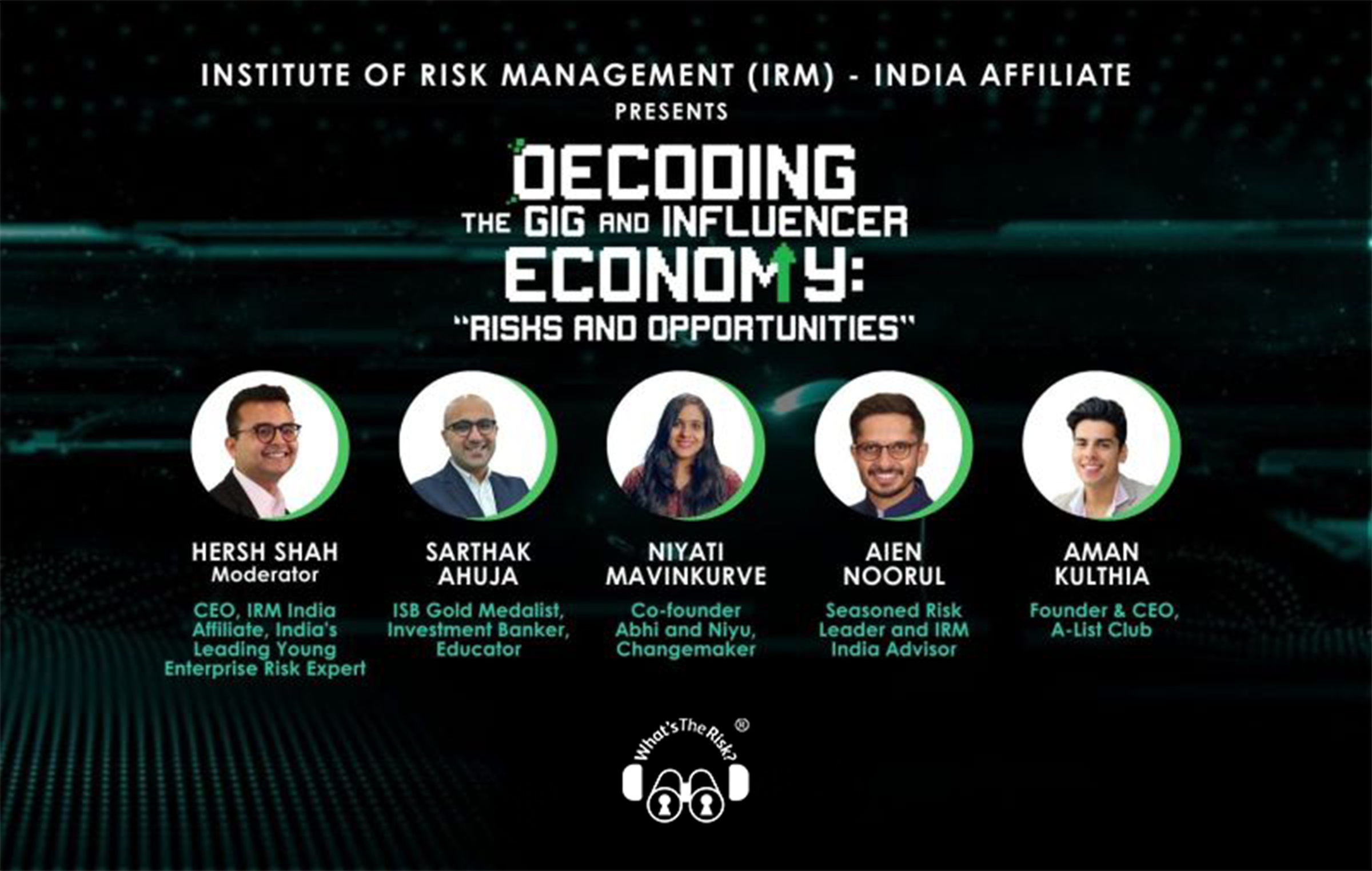


This article is the transcript of IRM India’s What’s The Risk® episode telecast on CNBCTV18. The What’s The Risk® initiative by IRM India Affiliate decodes risks and opportunities across diverse sectors with an objective of elevating the importance of risk intelligence and enterprise risk management as a skill, profession and business enabler.
Voiceover:
The Institute of Risk Management India Affiliate presents “Decoding the Gig and Influencer Economy: Risks and Opportunities.
Hersh Shah:
Imagine it’s 1925 and you’re sitting in a lounge listening to a live jazz performance by a group of musicians. That was the most common form of gig back in time. And these short-term engagements or performances – have been around for centuries, with musicians, artists, and craftsmen taking on gigs long before the term was popularised. But today 10 million Indians are engaged in contractual work as delivery executives, business advisers, web developers, translators, or project-based workers in any discipline. There’s also this creator economy where over 80 million Indians are working as digital content creators so-called as micro influencers or influencers in a range of sectors such as Finance, Fashion, Travel, Music and a lot more. Now, the frustration of a traditional 9-to-5 desk job along with an aspiration for multiple sources of income coupled with this exponential proliferation of technology and social media have made gig workers, creators and influencers realize that the need to work for a single employer or be on their payroll is no longer the dream career. In fact, today the gig and influencer economy in India possesses immense potential as the government and India Inc. increasingly recognising this sector as a vital engine for job creation and economic growth, but as they say you know, opportunity and risk come in pairs, so, this sector is equally vulnerable to a range of risks. In this context, here’s welcoming all of you to this panel discussion on Decoding the Gig and Influencer economy: Risks and Opportunities by the Institute of Risk Management India Affiliate. As the world’s leading certifying body in Enterprise Risk Management exams across 140+ countries, this special episode underscores our unwavering commitment to driving thought leadership in every sector and every discipline. Let me now welcome the experts on our panel. Joining me in today’s discussion are Sarthak Ahuja – who’s an ISB Gold Medalist, Investment Banker and Educator, Niyati Mavinkurve – co-founder of Abhi and Niyu, Aien Noorul – who’s a seasoned risk leader and adviser to IRM India, and Aman Kulthia – who’s the Founder and CEO of A-list club. Lady and gentlemen, thank you very much for joining me in today’s discussion. Aien Noorul (Seasoned Risk Leader and IRM India Advisor), let me start with you. The projection of the number of gig workers by 2030 is going to be about 25 million, and according to a recent survey, 8 out of 10 companies are now preferring to explore gig workers on a contractual basis. How are you seeing this transformational impact on India Inc. or corporate India? What are some of the emerging unknown unknown risks that one should really consider?
Aien Noorul:
What we are seeing currently is that the entire gig workforce is significantly expanding. Along with the gig workforce, the entire ecosystem, right from the gig platforms to the technology behind it, the regulatory environment around that, as well as how the companies are engaging with the gig workforce, these have been really expanding at a rapid speed. Currently, there are more opportunities that are available for the gig workers, more than ever. The companies are engaging gig workers across all the functions. Could be from Operations, to Logistics, to Legal, HR, Finance, IT etc. Some of the top risks to consider would be the regulatory environment with the evolving regulations around it, definitely aspects around classifications of the workforce, aspects around the fair compensations benefits to the workforce, be it in terms of the overtime, Insurance, etc. needs to be carefully looked at. Apart from that, given that a lot of gig workers are connecting remotely, there are risks from a cyber security point of view which needs careful consideration. Companies are sharing their confidential information and providing access to the gig workers.
Hersh Shah
The data privacy.
Aien Noorul:
The data privacy and the data security becomes an important aspect to look at. There are reputational risks also that are worth considering, not just in terms of how the gig workers are performing their duties, but also in terms of how companies are handling their own gig workers. So, these are all the relevant risks for the companies to proactively identify and then manage. Those would be my initial thoughts.
Hersh Shah:
I wish I could do a crystal ball gazing exercise with you at some point to see what are the Black Swans or Gray Rhinos in this area, but Aman Kulthia (Founder & CEO, A-List Club) let me bring you in at this point. You’re building one of the largest communities for creators and influencers, and traditionally, if you see the whole career landscape, one would want to become a Doctor, Lawyer, Pilot, Chartered Accountant, or so on and so forth. Are you seeing this as a great career opportunity for the Gen Z? Or even the Gen Alpha? What is your take on this?
Aman Kulthia:
I’ve foremost, at the closest, seen the rise in the world of creators, and definitely seen a perception shift about this world of creator economy. I think content creation is now finally being looked at as a viable career option that brings together loads of opportunities, whether it be as a career, or as a part-time gig, or something that you just do to get perks and access, and some opportunities that facilitate your current lifestyle. But for sure, having seen the trends in the recent market, and the future predictions based on these industries, I feel, creator economy in general, influencers and the rise of influencers is something that is almost guaranteed in the coming years.
Hersh Shah:
And what are some of the disciplines which are driving this demand, any specific area where you’re seeing creators thriving or influencers thriving?
Aman Kulthia:
Absolutely, I think it’s the growth of social media platforms in general, plus, the growth of usage of these social media platforms by the population. I feel, post pandemic, the online conversion rates, the online world, the online active user rate, has all shot up, and because of the same, creators almost had to be born. Because these are essentially, creator distribution platforms where content is distributed, so creators of that content had to be born, right. Hence, influencers are on the rise. As more and more of these platforms come up, we’re seeing domestic platforms come in, we’re seeing international platforms increase their consumption rate and adoption rate within the current population. So, it’s because of this segment, and this usage rate increase post pandemic, I feel influencers will grow.
Hersh Shah:
So at this point, Sarthak Ahuja (ISB Gold Medalist Investment Banker, Educator), you’re a brand strategist, you’ve been advising companies. I want to understand from you, from an influencer marketing standpoint, if you look at the average spend, 25 to 30% is now allocated towards influencer marketing from the total digital marketing spend. And if you look at the market size, it’s going to grow to about 3,500 crore. What is your view, in terms of the brand and reputation risk that organisations are likely to face. Because, you know, as and when you engage with influencers, there’s a certain script, there’s a certain contract. But then the downside is are they complying with those contracts? Or, like Aien mentioned, the code of conduct. Where do you see the role of reputation, brand in this whole space?
Sarthak Ahuja:
Sure, I think, for years there’s been sportspeople, there have been actors, who have actually been brand ambassadors for big brands, and we’ve all seen cases, without naming any, to notice how a certain celebrity would have engaged in something which is controversial, and a brand having pulled the plug on the brand ambassador contract. Now, I feel, with the creator economy and with influencers coming in the frame, earlier a brand ambassador – which is a celebrity – is aimed to be picked to think what would the ideal customer persona or the ICP really relate to. But if you think about it, everyone knows that the amount of incomes and lifestyles that celebrities have, the ICP actually doesn’t.Today the brand has an opportunity to actually pick an ideal customer persona and make them the influencer, to actually build a lot more authenticity, plus, a great feedback loop. So, I think, with the greater risk of tying up with influencers, or much smaller, you also get a more focused return on your spend. On a trade-off between risk and return, this still is a positively correlated line, as I would look at it. Apart from that, I think, as they say, you diversify your risk by actually diversifying your portfolio. These days brands really have the option, rather than going with one celebrity, to take a significant portion of that budget and allocate it across a pool of creators, which also means that if there is anything remotely controversial happening with a particular person, they can dial down on their engagement with that creator without really letting it totally impact the brand.
Hersh Shah:
Okay, great. Niyati Mavinkurve (Co-founder Abhi and Niyu, Changemaker), you are one of the powerful people on this panel as a woman creator, and your story is pretty inspiring. I want to ask you specifically from a DEI point of view, the Diversity, Equality, and Inclusion, what has been your story? How do you want to advise young women creators on breaking the stereotype?
Niyati Mavinkurve:
My advice to a lot of women who want to be content creators is that first, you’re going to be subjected to a lot more criticism as compared to a man, and a lot of this criticism is going to be personal. They’re going to come and criticize the way you look, the way you dress, the way you talk, and it doesn’t have anything to do with you as a person, it’s just the way people’s own limiting biases are. That’s the thing about creating content on social media, the reactions and responses that you get are very less about you and your work, it’s more about a lot of other people projecting their insecurities on you. So, as a woman, you have to have a little bit of that thick skin. The other thing is you have to find a tribe. When you actually find three or four of those women who will support you and push you no matter what, and you’ll find them even when you’re creating content, stick to those people, stick to those women. Having that tribe will be the thing that pushes you through, because that’s the backbone you’ll have.
Hersh Shah:
In fact, if you see the Niti Aayog report on the gig and influencer economy, which was released in 2022, there’s a separate section on Breaking the Stereotype and Social Inclusion. Well, it’s time for a break, but we’ll be back with this dynamic group to deep dive into the intricate and intertwined risk that organisations, gig workers and influencers will need to be prepared for in an era of constant change, fueled by technological advancements or the evolving business landscape.
Voiceover:
The Institute of Risk Management India Affiliate presents “Decoding the Gig and Influencer Economy: Risks and Opportunities”. (2x)
Hersh Shah:
Welcome back to this special panel discussion on Decoding Gig and Influencer Economy: Risks and Opportunities by The Institute of Risk Management India Affiliate. I’ve been speaking with Sarthak Ahuja, Niyati Mavinkurve, Aien Noorul, and Aman Kulthia. Aman, let me come to you. You deal with influencers, creators on a daily basis. Give us some ground reality on the risk that these individuals face.
Aman Kulthia:
The biggest risk, I feel, is Financial Risk. There is a constant fluctuation of income. That leads to financial instability whereby you cannot depend on an average monthly stipend that would be coming in, that is more employed to a regular 9 to 5 job. So, you have to be okay with the fact that some months would be seasonal months or festive months, whereby income looks good and you’re extremely happy with the amount of money that’s coming into your account regularly. But there could be months or days, and that could be prolonged periods, whereby you see almost no growth financially, and you’re barely surviving and covering your lifestyle cost. The dependency on these technological platforms – it plays a huge part in the need for risk mitigation. Essentially, algorithms of these social media platforms are constantly changing. Now, as a creator the amount of likes, comments, views, and reach I get is directly linked to the algorithm the platform is supporting. Any change in algorithm directly impacts my personal reach and engagement, and it’s the reach and engagement that actually derives my market rate. Any change there, which is not in my control, equates to my financial instability of sorts. So, there’s heavy level dependency. Also, we might have seen a case recently, or in the future, where heavy dependence on one technological platform or one social media platform for your entire portfolio and your income, could be wiped out with one government policy, or rule. So, diversifying your platforms, in a way where your content and your audience is distributed amongst many, will play a major part.
Hersh Shah:
Sarthak, I want to come to you on this point. The Financial Risk which he spoke about is very interesting. I was speaking to a couple of influencers, and they said they were denied financial assistance because they don’t have stability in income. As a chartered accountant and investment banker, can you give us some tips on how does one mitigate this financial risk?
Sarthak Ahuja:
I think a lot of it is 100% driven by the behavior of the person. I would say the gig economy ends up creating a lot of opportunities which are short-term, which end up making you a lot of money. What people do is, give up on their full-time job or a more stable career for working as a contractual knowledge professional for these short-term gigs and money-making opportunities, and extrapolate that expectation of money creation for years to come. The actual lifespan is going to be much smaller. So, I would say even though you may find certain engagements to not be as profitable as a few other short-term contracts would be, don’t give up on them entirely, because, know that those are the ones which will actually give you stability and predictability in your income, which actually reflects very well in your financial statements as well when you go for a credit assessment to a banker. The second is from a living cost perspective, this was from an income point of view. From a cost perspective, it’s very easy to increase costs on your lifestyle but very difficult to bring it down later. So, I think all the money that comes in, realize that this is short term and it should be put towards an emergency.
Hersh Shah:
Isn’t that a requirement of staying in the industry?
Sarthak Ahuja:
I think it’s a requirement, it’s an aggravated requirement of being in this industry, where for anyone else you would probably give away these insights, as this is behavioral finance and you need to behave in a particular manner which is financially prudent. But, it becomes all the more necessary for creators, because a lot of them probably haven’t gone through years of struggle of saving up a couple of lakhs or 10 lakhs or 20 lakhs, and suddenly you make that kind of money in one month. Your mindset tells you I can splurge on this, let me splurge on this, not realizing that for most other people, and you could find yourself in that spot.
Hersh Shah:
How do you see this spanning out for delivery executives or some of the gig workers?
Sarthak Ahuja:
I think even for delivery executives, what is happening is that they see one platform trying to compete with the other, to take away all of these delivery executives onto them with some short-term incentive, and they jeopardize everything else that they’ve built, or they jeopardize by not really adding to their skill base, which is an active way of constantly earning money. If you’re only spotting trends, you may be able to ride one wave but possibly not every wave that comes after that. So, I think, with creators, with gig workers, know that every opportunity is short-term. Build something which is long-term, which could possibly be constantly upskilling yourself.
Hersh Shah:
Niyati, talking about the risks of the gig workers and influencers, there’s one important component about long-term sustainability. I’ve seen certain creators having mental health issues because they lose followers. How do you stay relevant in an era of competitive change, technological advancement, or like he said, the algorithms changing. How does one really stay relevant and make sure that you’re building something long-term?
Niyati Mavinkurve:
Your content doesn’t get irrelevant, the content creator gets irrelevant, or they decide to move away from whatever they’re doing and transcend and work in other stuff. It’s very important as a content creative to find your voice. I know it’s very tempting in the beginning to just ape whatever is trending, or make videos on trending audio, or to figure out, okay maybe I can do 10 different transitions like this, but then that is not something that’s going to give you long-term happiness, because these trends will come and go. Tomorrow if you put out some piece of content, and it doesn’t perform because it’s not on trend, that’s going to cause a lot of mental health issues. So, one of the risks, since we’re talking about risks here, is definitely the risk of burnout, simply because a lot of creators don’t manage their expectations well. It’s very important to understand that creating content is a lot like starting your own business. There is a certain amount of gestation period involved in this, and it’s like throwing a dice, you never know whether you’re going to get two sixes in the first try, or you’ll get it in the 10th try or the 100th try.
Hersh Shah:
There’s no formula for that.
Niyati Mavinkurve:
There’s no formula. Your first video could go viral, but that does not guarantee your second video will. Your 10th video could go viral, your 15th video could go viral. For us, it was the 22nd video that we made when we started 100 reasons to love India, that went viral. That was a video on eco-friendly Ganpati, and we thought that life is going to change, everything will be different now. We got a lot of followers, but then the next video didn’t perform that well, and we learned a very important lesson that the up and down spikes are not enough. The spikes will continue.
Hersh Shah:
The risk of not being accepted, the risk of being trolled, the risk of being bullied.
Niyati Mavinkurve:
The risk of being trolled is always there, we have a fourpoint system to deal with it. There are going to be people who are going to make personal attacks, like I mentioned before. So, people who make personal attacks on your appearance are the ones you should never engage with, because they are the ones who have their own limiting biases. Then, there are people who will just nitpick on a lot of different things, those you may engage with if you want to. There’ll be people who will give you constructive feedback like – maybe you can do this to improve your work, maybe your lighting can be better, your audio can be better. These people come with a very good intention and you can engage with them wholeheartedly. Of course, you’ll find your 97% silent base, 99% silent base, who are always there to support you, who will not comment on every video of yours, but if something touches them then they’ll pour their heart out with affection for you. Those are the people you engage with.
Hersh Shah:
So, this is about influencers and creators. Sarthak, I want to quickly bring you in. Speaking of the gig workers specifically, do you think they need to be included in the mental wellness programs by the large corporates. Are you seeing that happening?
Sarthak Ahuja:
Absolutely, I think one common mistake people tend to make is they think of it from the perspective of Maslow’s need of hierarchy, saying that these people possibly just need to take care of Money Matters, and you know anything related to mental health and depression is a first world problem of the top tier, which is so far from the truth. The fact that these people don’t really get a voice to put it out on public display on social media, or in movies, doesn’t mean that they’re not dealing with it, which is why I was really happy to hear the other day, about this one free helpline in a nonprofit organization, started for giving free on-call assistance to any woman who wants to call and get some mental health support. I think more such initiatives are really required in the country today.
Hersh Shah:
Aien, let me come to you to kind of conclude this panel discussion. The essence of a good Enterprise Risk Management programme is about the coverage or the scope of risk. Have you really looked at the Risk Universe? Have you brought in a 360° perspective? Are you seeing corporates include gig and influencer risk in their risk register? Is it part of the overall governance? Is it part of the risk culture? How are you seeing that change?
Aien Noorul:
So absolutely, I agree with you Hersh, the risk management and a robust risk management framework goes beyond just the culture building and the awareness. There are various different elements that need to come together for it to be a holistic perspective. It could be about having risk champions identified across different functions. The responsibility doesn’t lie with just the risk management function, the responsibility lies with every single function within the organisation – could be Operations, could be Legal, could be HR etc. Apart from that, there has to be an acceptance to the change that is happening around us, and for that there’s a need to proactively identify those risks. Make sure that there are deliberations and discussions and a continuous engagement with the people to identify what can go wrong and then accordingly decide on the mitigation strategies. Some of the mitigations or the guardrails that a corporate can build-in could be with respect to the contractual agreements and the clauses that gets included, strengthening the cyber security and the data privacy protocols and measures that have been put in, and having very clear protocols and policies with respect to how the gig workers are handled – What are their ethical behaviors that they are they supposed to be handling? Making sure that there are very clear requirements in terms of how the organization is going to be handling any scenario that may come up. So, it could include conducting different scenario planning and handling the adverse publicity that could come up with this. These are the things that could be managed.
Hersh Shah:
All right. On that note, thank you esteemed panelists for that engaging conversation. Delving into a subject like this can occupy hours, but today’s discussion will surely drive the importance of building resilience in the gig and influencer economies through effective risk intelligence, stakeholder collaboration, as they said, and regulatory intervention. Thank you!
Voiceover:
The Institute of Risk Management India Affiliate presents “Decoding the Gig and Influencer Economy: Risks and Opportunities.