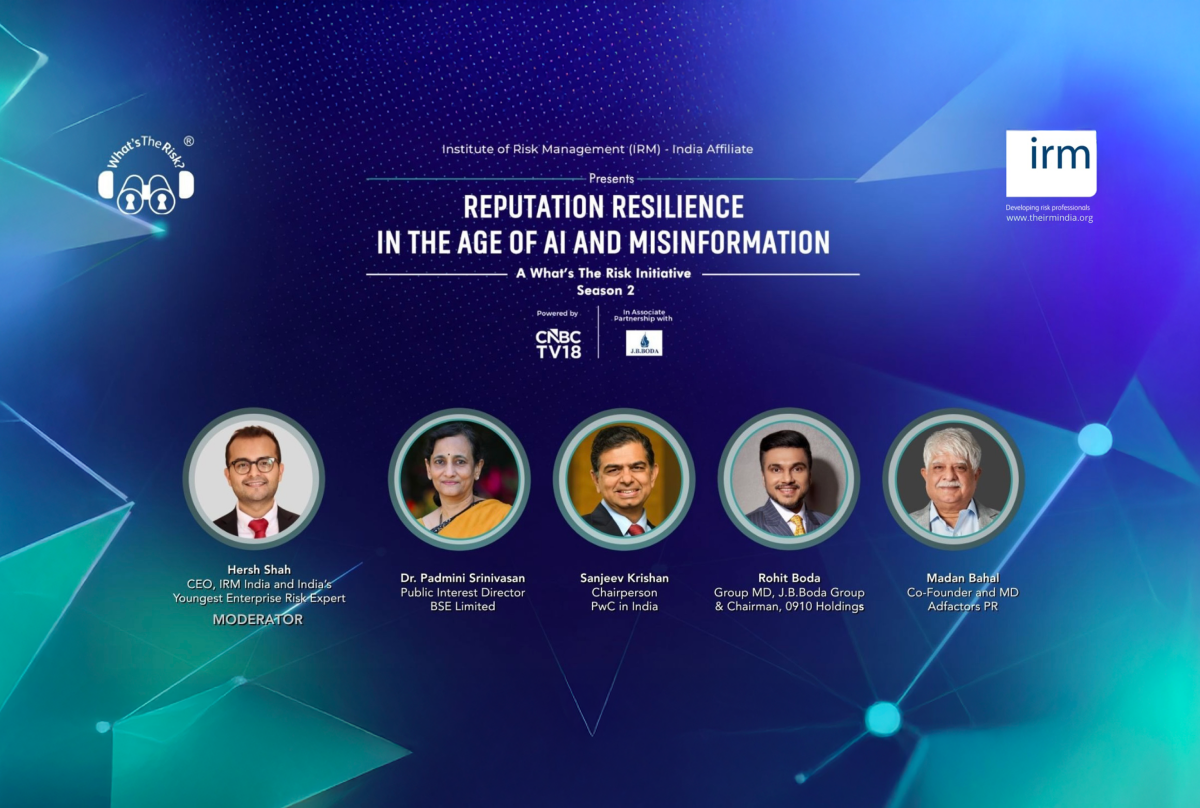


This article is the transcript of IRM India’s What’s The Risk?® episode telecast on CNBCTV18. The What’s The Risk?® initiative by IRM India Affiliate decodes risks and opportunities across diverse sectors with an objective of elevating the importance of risk intelligence and enterprise risk management as a skill, profession, and business enabler.
Voiceover:
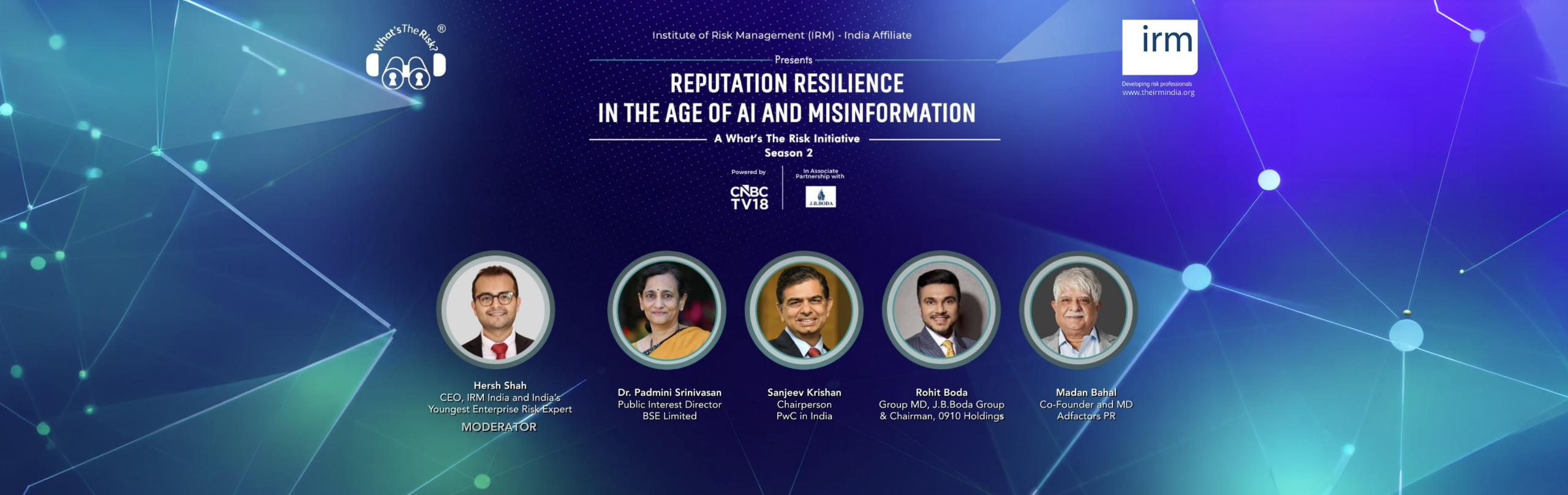
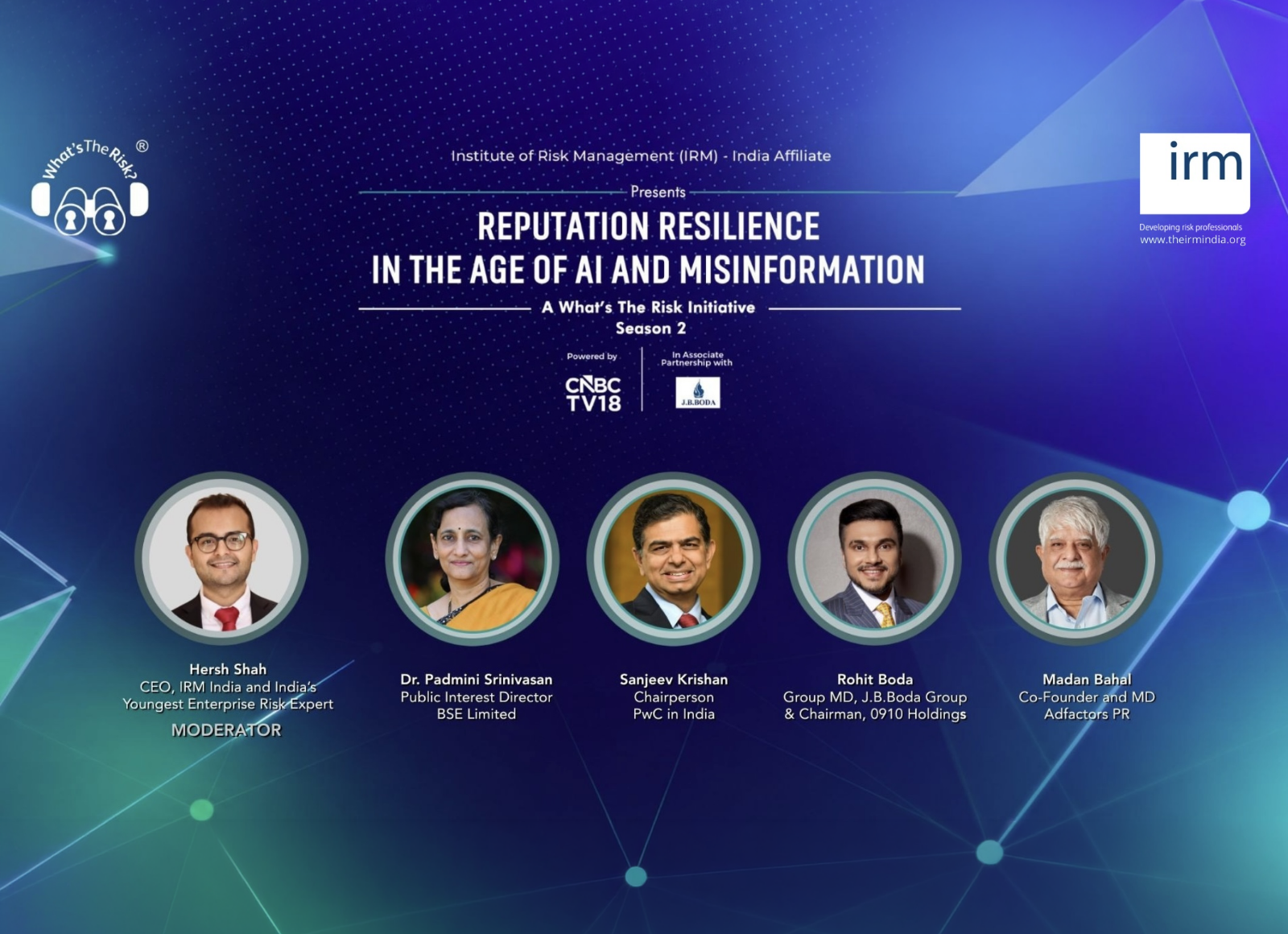
Institute of Risk Management India Affiliate presents Reputation Resilience in the Age of AI and Misinformation — A What’s the Risk?® Initiative, Season 2, in association with J.B. Boda Group.
Hersh Shah:
A CEO wakes up to a video of himself going viral, admitting to a failure he never spoke about. Within minutes, the content is amplified across digital ecosystems. Customers withdraw, employees question leadership, and stakeholders respond to a version of reality that isn’t real. By the time the truth emerges, the narrative has already settled. Because in today’s world, narratives move faster than facts and trust is shaped before verification even begins. Now, this is the new reputation battlefield. Not very long ago, reputation was built over years through consistent performance, stakeholder trust, and carefully managed communication. But today, it can be challenged in minutes by AI-generated content, deepfakes, and even bot-driven amplification. In fact, the World Economic Forum has identified AI-induced misinformation as one of the most significant global threats, pushing it beyond communication risk into the core of boardroom decision-making, governance, market perception, and even, leadership accountability. In this context, the focus must shift from managing reputation to building resilience, especially when brand and trust itself can be distorted or destabilised without warning. So, here’s welcoming you to the panel discussion on Reputation Resilience in the Age of AI and Misinformation by the Institute of Risk Management India Affiliate in associate partnership with J.B. Boda Group. As the world’s leading certifying body for ERM exams across 140+ countries, the What’s the Risk?® initiative underscores our unwavering commitment to driving thought leadership in every sector and discipline. Joining me in today’s episode are Dr. Padmini Srinivasan, Public Interest Director, Bombay Stock Exchange Limited; Madan Bahal, Co-founder and Managing Director, Adfactors PR; Rohit Boda, Group Managing Director, J.B. Boda Group & Chairman, 0910 Holdings; and Sanjeev Krishan, Chairperson, PwC in India. Lady and gentlemen, thank you for joining me in today’s episode.
Panelists:
Thank you.
Hersh Shah:
Madan Bahal (Co-Founder & Managing Director, Adfactors PR), you’ve been an adviser to India Inc. How are you seeing the current situation of reputation evolving in the boardrooms, and are boards and leaders really looking at this as a strategic asset?
Madan Bahal:
A lot of your valuation, market capitalisation, is due to intangible assets, and the biggest building block of that intangible asset is the reputation of an organisation. Your customers, your various constituencies draw comfort from that fact, and that’s how trust shapes. There’s another reality, and that’s the explosion of risks, and consequently, the explosion of reputation risks because reputation risk is not an independent risk; it is a risk that is derived from another risk, it’s the mother of all risks. When you take that reality, we are having so many things, and the post-pandemic world has particularly become a landmine of such risks. Whether it is geopolitics now that has impacted so many industries at one go, whether it is cybersecurity, whether it is artificial intelligence or social polarisation in societies, I think the list is just increasing, and for some, it might become a very overwhelming kind of a situation. Whether the organisations are prepared to deal with such a situation? Mostly not. The escalation has been so fast. The old systems and protocols for managing risk or reputational risk, the risk registers, the risk committees, I think, maybe a little bit outdated, and we need to bring in some new, fresh thinking into this whole idea and this whole notion. While some of the external risks cannot always be anticipated and controlled, seven out of ten crises that we are seeing are happening because of something that was happening internally, some breach, some indiscipline, some poor conduct, executive conduct. A whole body of these things is happening, and I think, to that extent, organisations will do well to revisit everything that is connected to risk and reputation.
Hersh Shah:
Okay. Rohit Boda (Group Managing Director, J.B. Boda Group & Chairman, 0910 Holdings), let me bring you in at this point. You know, reputation as a risk remains very difficult to insure in a traditional sense. So, from your lens, why do you think pure reputation insurance is still nascent, particularly given the challenges in quantifying the impact or defining the triggers?
Rohit Boda:
So, Hersh, today, the buzzword is, “Let’s go viral.” Now, going viral is not a sin, but the problem comes in when the perception of the market, the perception of the community, changes. Now, when we talk about insurance, insurance basically thrives on certainty, and reputation is built on perception. Quickly, in 30 seconds, what is reputation insurance? It basically covers your financial losses in terms of your digital exposure going wrong, your brand valuation or your personal company or the personal valuation goes for a toss, your positioning in terms of how you are perceived from the community, and then it covers the costs related to crisis management, your PR, your legal, etc. Now, how do you quantify a reputational loss? I mean, if there’s motor insurance or fire insurance, it’s very easy to quantify a loss, but to quantify reputation is an extremely challenging task. It could be a shift in leadership perception, it could be market sentiment moving around. Now, a post going viral or a company getting attacked by hackers, your data getting leaked, the trigger could be anything. And then today, in the world of AI and digital disruption, and the penetration of the internet because of which more and more people on the planet are getting hooked to smartphones and social media, this becomes all the more a sensitive element. From an insurance parlance, one of the most challenging elements here is that reputational insurance or reputational risk does not have historical data. Now, anything that does not have a history becomes an extremely challenging concept to price, and the cost element eventually gets triggered. Of course, all said and done, at the end of the day, the awareness of reputation insurance in organisations, or even for influencers, fininfluencers, all of the humans on social media, is hardly there. They are not aware or they are not worried about what will happen if something goes for a toss, especially when their income or revenue stream comes from this channel, where reputation comes in. So, yes, there are a very limited number of players in this space. It’s a very niche, very complex space to underwrite, but also the uptake and awareness is something that will take some time to grow.
Hersh Shah:
Dr. Padmini Srinivasan (Public Interest Director, Bombay Stock Exchange Limited), I’ll just come to you now. You know, markets today are not just responding to information or performance, but also to the credibility and timing of that information. So, in this age of AI and misinformation, are you seeing risks around selective disclosures, transparency issues, or narrative-driven communication take away investor confidence or erode market capitalisation?
Dr. Padmini Srinivasan:
The financial performance and the financial statements talk about a true and fair view. So, they are based on assumptions, judgements, estimates, and of course, the timing of disclosure. So, that’s one aspect. The second aspect is that you have 500 pages of an annual report, and no investor has time to read through the entire 500 pages. So, what has happened is, moving from pure numbers, we move to the narrative, and what has happened in the narrative is that there is a lot of information that needs to be explained. The financial numbers need to be explained so that investors can take decisions based on those numbers. Now, because you’re focusing on narratives, what is important is that the narratives themselves have become a tool for obfuscation. They have become a tool for hyping, spinning, and also a variety of ways in which you do not inform or you keep the language very difficult for investors to follow, and so on. Now, what has happened in this entire narrative is that because it has now become a tool for informing the financials of the business, people have used narratives for their own purposes, to suit their own requirements, leading to a lot of asymmetry of information in the market. And here comes the classic lemons problem, where asymmetry of information will ultimately lead to the fall of any market, whether it’s the capital market, product market or financial markets, because you don’t have clear, credible communication. Now, this whole narrative, from a traditional perspective, is changing with AI. So, with AI, what has happened is that companies are able to link the narrative to the numbers in a very credible form. Let’s say if a company is not doing well or has very poor performance, you can spin that with the help of a good narrative, saying, “We are poised for significant growth.” Basically, we cannot do any worse than what we are already doing today. So, the issue is, how we use an AI tool to give a narrative is changing, at least from a corporate perspective.
Hersh Shah:
So, even poor performance is celebrated or glorified?
Dr. Padmini Srinivasan:
Yes. And you can use AI tools to spin it in such a way that you don’t really talk about important things, but you talk about things that you want to showcase, and so on. The other aspect is, of course, the same AI tools can be used by regulators, investors, and others to cut through whatever you’re saying and go to the depth of the actual performance. So, it’s a double-edged sword.
Hersh Shah:
Sanjeev Krishan (Chairperson, PwC in India), finally coming to you. Consulting firms are increasingly moving beyond traditional audit, compliance, and even, risk advisory into what one might call, a trust and reputation architect ecosystem. So, how do you see this role evolving, particularly in embedding reputation within ERM, or ESG, or even, governance frameworks? And how does one bridge the gap between boardroom intent and execution, something that Madan and Rohit already spoke about?
Sanjeev Krishan:
Traditionally, if you look, we were always brought in to address specific issues. There could have been audit gaps, there could be compliance lapses, and some other risk events. Today, however, there’s been a shift. The conversation starts much earlier, and it is far broader. Organisations today are asking, “How do we build and sustain trust with all stakeholders?” And we are talking about stakeholders, which is broader — customers, regulators, investors, employees, all of them are included. So, what’s changed is that reputation, when you talk about that, is no longer seen as, in some ways, intangible or reactive. It is now something that can be engineered, measured, and indeed actively managed, and we just heard about that. So, for us as consulting firms, we’re increasingly embedding reputation risk directly into, what you just said — ERM, ESG agendas, and of course, governance frameworks. And the intent really is to make sure that it is no longer just a matter of intent; we want to actually move beyond intent. It is not just that we want to be trusted, but it is to actually operationalise that intent across the organisation, and I think that’s where the big impact for us is going to be. So, let me articulate three critical roles that firms like us could play today. I think the first is, really, the translation piece, which is bridging the gap between what the boardroom vision is, and I just mentioned that, to what the on-ground execution ought to be. It’s one thing to define the values that are going to be there at the top, it is quite another to make sure that whether it is corporate, whether it is executive incentives, whether it is the decision-making that they do, or indeed the behaviours that they espouse, I think not just for them, but all the employees in the company, that is the first one, that we translate the intent into action. The second one is, really, about measurement, and when I say measurement, it is really, helping organisations define what trust actually means for them. So, this could include customer sentiment, the track record they have with the regulators, employee advocacy, it could mean their ESG scores, or even, the speed and transparency of the response when a crisis hits them. So, in some ways, the idea is to create some reputation KPIs that can be tracked, just like we track some financial matrices. And we just heard why there is a need to potentially invest and embed them, and what numbers may and may not tell at times. The third one, really, is integration. This is about ensuring that the reputation considerations are not siloed, because invariably one sees that they get siloed in communications or in PR, but they get embedded into the core business processes like supply chain, product design, compliance and digital strategy. So, this is really the key shift that one is trying to bring. For us, reputation is measurable, it is monitorable, and it is manageable.
Hersh Shah:
All right, it’s time for a short break. We’ll be back with this powerful panel to discuss how AI, misinformation, and leadership accountability are redefining the foundations of reputation and trust. Stay with us, we’ll be right back.
Voiceover:
Institute of Risk Management India Affiliate presents Reputation Resilience in the Age of AI and Misinformation — A What’s the Risk?® Initiative, Season 2, in association with J.B. Boda Group.
Hersh Shah:
Welcome back to the second episode of Season 2 of IRM India’s What’s the Risk?® Initiative in associate partnership with J.B. Boda Group. I’ve been in conversation with Dr. Padmini, Madan, Rohit and Sanjeev. Madan, coming back to you. In this age of AI, misinformation, and even, digital amplification, you guys run one of the largest PR firms in the country. Are you seeing an evolution of reputation risk in the boardroom or even in organisations? What’s the landscape looking like?
Madan Bahal:
I don’t think the response is at the speed of the risk evolution. There’s a huge lag between where the complexity is heading and the way most people respond, or even, the way we are able to respond. AI risk, particularly, has industrialised, so to say, what was already there. The risk was already there, but now, somebody can do it very cheaply, very fast, and amplify it all over. Bots then pick it over. When the bots pick it over, it gets amplified, the aggregators pick it up, and what the aggregators pick up goes into the media as well, and then from there it goes to the generative engines. Once it is there, it becomes like a long-lasting affair, because the discovery of your reputation now happens through the generative engines, and long-lasting damage gets caused; one has to be prepared for it. The biggest preparation is having a robust, let’s say, reputation vaccine, where you have implicit trust with your stakeholders, where they believe you, they trust you. And if something were to come which was fake or driven by a threat actor, so to say, then the way they absorb it is with that layer of trust. Of course, you have to be prepared. You have to do continuous monitoring now. Stakeholder intelligence is a new word. Like artificial intelligence is a new stakeholder, stakeholder intelligence is a new word. And all these preparations have to be done so that, if something happens, you have to catch it very fast. The team that will work on it — the lawyer, the public relations person, the risk person, the finance person, the HR person, the CEO’s office — they have to come together very, very fast and take stock of the situation and respond, because if the golden hour is lost, a lot of damage gets done. Reputation rehabilitation is now a long-term affair because the footprint is created so rapidly that if you have not reacted fast enough and well enough, then the damage is considerable and the damage is lasting. Are many people prepared? The answer is no, not yet.
Hersh Shah:
Rohit, you spoke about insurance, but how do you really begin to price the intangible, whether it’s loss of trust, brand equity, or even, market sentiment?
Rohit Boda:
How does an insurance company price the loss of trust? How does brand equity or the perception of people towards a brand change, or the market sentiment change? It’s a highly speculative risk. It is not a pure risk. But quite a lot of data is getting collected through various means like the ESG scores, the credit scores. There is a lot happening on social media which also is, not only uploading and downloading, but is also a part of the formation of the entire data of an individual or an organisation. So, all of these elements do get into the element of pricing. All of these elements are part of the underwriting manual of reputation insurance, and it is not only about today or it is not a local phenomenon, but even after 25 years, the definition of reputation might change. So, every single day, pricing a reputational risk is going to be a challenge because of the massive disruption of AI. The number of people coming on board, looking at you, looking at your behaviour, what are you guiding the audience on, what are you positioning and portraying yourself as in front of the world, is always going to be a part of the underwriting strategy. But yet, there will be a time when there will be sensitivities involved in how the actuaries look at pricing a reputational risk. So, it is always going to be a two-edged sword. On one hand, you manage the reputation, you have to be seen. I always say attention is the new currency, but then that comes at a cost. And then on the other side, when it comes to underwriting or transferring the risk through the means of insurance, the question of data comes in, awareness comes in, and most importantly, are the organisations or individuals ready to pay that premium or the price for such a complex product.
Hersh Shah:
Dr. Srinivasan, let’s step back from markets to governance because you sit on the boards of companies and you’re a corporate governance enthusiast. Are you seeing the breakdown in financial reporting, or even, disclosure discipline have a catastrophic impact on the reputation of companies? And if so, why are those failures so difficult to handle?
Dr. Padmini Srinivasan:
In a way, it’s not just an event which has happened on one day. When you talk about reputational risk and you talk about financials, they have actually started much earlier. Catastrophic failures, and failures in general, do not happen in one day. They are the cumulative effect of many small failures in the organisation. And most of them start with cooking the books. That’s where the whole narrative starts on the financial numbers and the risks that come out of this. So, fixing that, a good oversight, good internal controls, are all part of the risk management. Secondly, when you look at risk, I always say, if you don’t find risk, risk will find you. And that’s very true for reputational risk as well. Today, if you look at companies, you look at the financials, that’s where we start. But then over a period of time, you have to ensure that building a reputation is an endeavour which is built brick by brick and it encompasses trust, transparency, accountability, and equity to all stakeholders. And it all starts with that mindset. When you say there is a crisis, the crisis is a manifestation of a series of things that have gone wrong earlier. It’s not just a one-off event. It has already begun somewhere way back. And what happens today is only the manifestation.
Hersh Shah:
Sanjeev, finally, closing with you. As organisations become increasingly data-driven, reputation is closely tied to how that data is also governed. So, building on what Dr. Srinivasan said, how do issues like data privacy, AI ethics, and algorithmic transparency shape the reputation landscape?
Sanjeev Krishan:
If we just look at customers, almost 82% of the internet users do express deep concern about how their data is being collected and how their personal data is getting used. We, at PwC, had a consumer insight survey some time back, and that showed that 82% of customers consider data protection almost as a non-negotiable. So much so that 44% also said they are willing to pay a premium if they know their data will be protected. There was another customer survey which showed that 48% of customers have actively stopped purchasing a brand from which they had a data privacy concern. Now, on one hand, we’re talking about all these data privacy concerns which a customer has, and if you look at it from a CXO’s perspective, they look at it from an enterprise perspective. They are obviously very concerned about cyber breaches, and we’re seeing more and more of these, particularly with some of the developments in AI, and some of these we’ve been talking about, the last 2 weeks in particular. So, 57% of CXOs, and this is prior to a survey before the launch of Mythos, they said they were anticipating cyber breaches and that was their biggest concern in building customer trust. And of course, when you talk about AI, there is also algorithmic bias which can come in. So, in a way, if you look at it, the whole trust measurement landscape, in some ways, it is lacking, what I would call, structured matrices. Today, I think, very few people, I would say maybe 20-30%, believe there is a reliable way for them to do so. There is a process to be able to get to these matrices, and we spoke about some of this earlier, but I think, three things, again, become very, very critical until we get to that stage. Very clear communication about data use becomes very, very critical if one wants to build trust. I think, the second one, is to let privacy be enforced by design. I mean, even on our phones, we have the incognito mode, right? Why doesn’t that become the default mode, for instance? I mean, I’m just trying to bring it to life. And the third one, really, is can we actually be very, very prompt about breach notification? So that, the moment something happens, we are telling the people, we are showing that there is vulnerability, but we are actually being transparent about it. That will build confidence. So, I think, there is a process to get to where we wish to, but, I think, some of these steps on the way will help.
Hersh Shah:
Well, that brings us close to a deeply relevant and thought-provoking conversation. Reputation, today, is no longer a communications outcome. It is actually a governance responsibility with direct financial consequences, as highlighted by the panelists. It is also measurable, monitorable, and increasingly tied to valuation, stakeholder trust, and long-term enterprise resilience. Boards that fail to treat it as a structured risk are, in effect, carrying an unpriced exposure on their balance sheet. I think, the shift is clear from reactive, PR-led management to formal ownership, oversight, and integration within enterprise risk and decision-making frameworks, with integrated alignment across leadership, including Chief Risk Officers, chief communication, marketing, and even, brand officers. A sincere thank you to Dr. Padmini Srinivasan, Madan Bahal, Rohit Boda, and Sanjeev Krishan for partnering on this important conversation. Stay tuned for the next episode of What’s the Risk?®, as we continue to explore how organisations can build resilience in an increasingly complex and contested environment.
Voiceover:
Institute of Risk Management India Affiliate presents Reputation Resilience in the Age of AI and Misinformation — A What’s the Risk?® Initiative, Season 2, in association with J.B. Boda Group.