

G.D. Naidu’s remarkable journey shows us that innovation is rarely about avoiding risk. It is about taking the right risks before everyone else is ready to.
When we celebrate innovators, we usually celebrate what they created. We talk about inventions, businesses, patents, technologies and breakthroughs.
What receives far less attention is the risk that existed before the breakthrough.
Before an invention works, there is technology risk. Before customers buy it, there is market risk. Before a factory produces it at scale, there is execution risk. And before society accepts a radically different idea, there is often reputation risk.
The life of Gopalswamy Doraiswamy Naidu (1893–1974) is a fascinating Indian example of this relationship between risk and innovation.
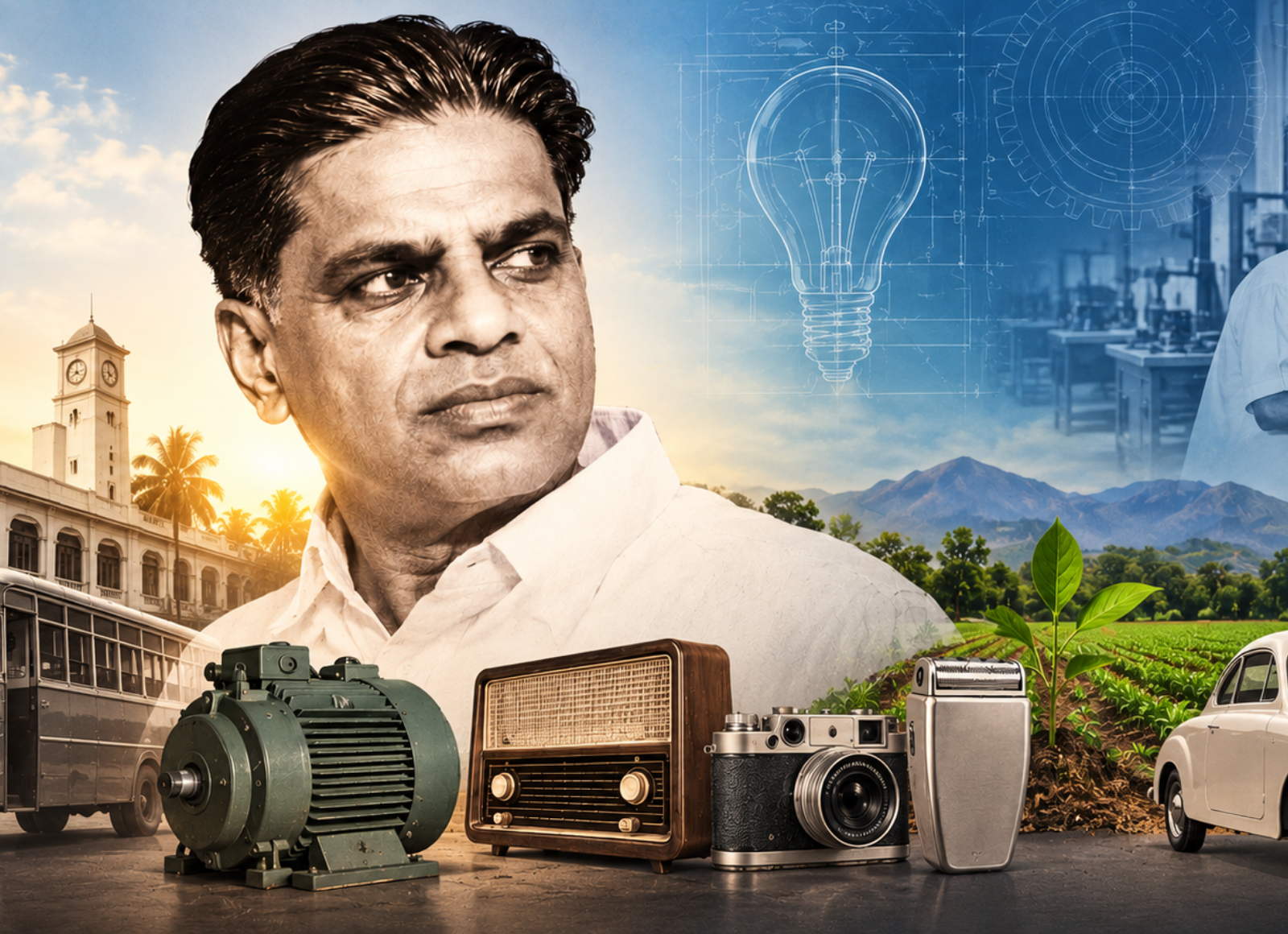
Popularly called the “Edison of India,” the Coimbatore-based inventor and industrialist worked across transportation, electrical engineering, automobiles, electronics, consumer products, agriculture and technical education. His experiments and enterprises included electric motors, radios, recording and counting devices, automotive components and several other technologies.
What is particularly remarkable is that this technological journey was undertaken by someone with very little formal education.
Viewed through the lens of Enterprise Risk Management, Naidu’s life offers an interesting proposition:
Perhaps the greatest innovators are not people who avoid risk. They are people who develop an unusual risk appetite for uncertainty when they believe the potential reward is worth pursuing.
Here are eight risks that defined G.D. Naidu’s journey.
Risk 1: He Took a Capability Risk — Learning by Doing
Naidu did not enter engineering through the conventional route of formal technical education. His education was limited, yet his curiosity about machinery developed into practical technical capability.
That represented a substantial risk.
Without degrees, institutional infrastructure or an established professional pathway, he had to depend heavily on observation, experimentation and self-learning.
But what appeared to be a disadvantage eventually became part of his distinctive approach to innovation.
Instead of separating theory from application, he learnt through interaction with machines and real-world problems. That philosophy would later become central to the educational institutions and science initiatives associated with him.
The lesson is not that formal education is unnecessary. It is that capability can also be created through experimentation.
For organisations, the equivalent question is powerful: do we allow people to experiment outside the precise boundaries of their qualifications and job descriptions?
Innovation often starts there.
Risk 2: He Took Entrepreneurial Risk — Starting with a Bus
Before becoming synonymous with invention, Naidu built his presence in transportation.
He began with a single bus and eventually developed a substantial bus operation. The G.D. Museums records that his fleet ultimately expanded to around 600 buses.[1]
Consider the business risks involved.
Vehicles require capital. They break down. Routes have to be managed. Passengers expect reliability. Maintenance failures create operational risk and disruption. Expansion creates workforce and management challenges.
Yet the transport business gave Naidu something equally important: problems worth solving.
The need to repair and service his buses efficiently encouraged him to manufacture spare parts himself. That interest subsequently expanded into industrial manufacturing.
It demonstrates a recurring pattern in innovation.
Risk creates problems. Problems create the need for solutions. And solutions can create entirely new businesses.
Risk 3: He Took Technology Risk — Experimenting Beyond One Field
Naidu refused to remain confined to a single technological domain.
Among the innovations attributed to him are electrical motors, radios, electronic counting equipment, recording machines and camera-related devices. Contemporary accounts also associate him with inventions such as an electric razor, vote-recording machine and juice extractor.
This breadth matters.
Every time an innovator moves into an unfamiliar technological area, uncertainty increases. Knowledge from one discipline may not transfer perfectly into another. Prototypes can fail. Money and time can disappear into experiments that produce no commercially useful result.
The safer strategy would have been specialisation.
Naidu repeatedly chose exploration.
Modern organisations frequently speak about innovation while simultaneously demanding predictable returns from every experiment. The two expectations can conflict.
If the outcome of every innovation project is already known, it probably isn’t much of an innovation project.
Risk 4: He Took Industrial Risk — Choosing to Manufacture
Inventing something and manufacturing it are very different challenges.
Naidu’s industrial ventures produced a wide range of products and components in Coimbatore, including radios, capacitors, resistors, radiators and other equipment. His work is also associated with the development of an indigenous electric motor in the 1930s.
Manufacturing converts technology risk into a much wider risk universe.
Now there are suppliers, machines, workers, quality standards, production costs, working capital and customers to consider.
A prototype only has to prove that something can work.
A factory has to prove that it can work again and again at an economically sustainable cost.
Naidu was willing to cross that divide.
That willingness is one reason his legacy extends beyond that of an inventor. He was also an industrialist.
Risk 5: He Took Market Risk — Betting on Affordability
A recurring feature of Naidu’s work was his interest in making technology practical and accessible.
His innovations were not restricted to scientific curiosities. Radios, razors, automobile components and other devices addressed actual consumer or industrial needs. His enterprises manufactured products intended for real use.
This introduces another uncertainty: Will the market accept the innovation?
A technically superior product can fail if customers do not understand it, cannot afford it or simply prefer an existing alternative.
Innovation therefore requires more than technological imagination. It requires assumptions about human behaviour.
Naidu repeatedly made those bets.
Today, we might describe this as customer-centric innovation. In his era, it meant something more fundamental: believing that technology should solve practical problems rather than remain inaccessible to ordinary users.
Risk 6: He Took Global Exposure Risk — Learning From the World and Bringing It Home
Naidu travelled internationally and visited companies in Europe and the United States to study emerging technologies. When he encountered interesting machinery or products abroad, he brought examples back to India and used them to educate others about technological developments.
This was not passive observation.
He converted exposure into experimentation.
The important distinction is between copying technology and learning from technology.
Naidu studied what other industrial economies were doing, examined technologies and then pursued manufacturing and innovation in India.
For today’s organisations, the equivalent strategy risk is intellectual complacency.
Companies can become so comfortable with their existing operating model that developments outside their industry, geography or immediate competitive environment are ignored.
Naidu’s behaviour suggests the opposite mindset:
Look outside. Learn quickly. Bring knowledge back. Experiment locally.
Risk 7: He Took Cross Sector Risk — From Engineering to Agriculture
Perhaps one of the clearest signs of Naidu’s appetite for experimentation was that machinery did not define the limits of his curiosity.
His work extended into agriculture, where he experimented with cultivation and crop development. His broader body of work crossed electrical, mechanical, automotive and agricultural fields.
This is an important form of innovation risk because crossing industries removes familiarity.
Agriculture introduces variables that engineering cannot completely control: soil, weather, biology, disease and growing conditions.
Yet multidisciplinary experimentation is often where unconventional ideas emerge.
Today we celebrate intersections such as AI and healthcare, finance and behavioural science, biotechnology and agriculture, or climate science and engineering.
Naidu demonstrated the same instinct decades earlier.
He did not ask only, “What industry am I in?”
His behaviour suggests a more powerful question:
“What problem can I solve?”
Risk 8: He Took Failure Risk — And Continued Experimenting
This may be the most important risk of all.
Not every experiment becomes an industry. Not every prototype becomes a successful product. Not every innovative idea receives the ecosystem support required to reach scale.
Yet Naidu continued experimenting across an extraordinary range of areas throughout his career.
His legacy therefore cannot be understood simply by counting successful products.
It should also be understood through his portfolio of attempts.
This is highly relevant to contemporary innovation.
Organisations often celebrate innovation but punish unsuccessful experiments. Employees quickly understand the contradiction. If failure damages careers, budgets or reputations, people naturally choose safer ideas.
True innovation requires a different approach to risk.
It requires distinguishing between intelligent failure and reckless failure.
Reckless failure comes from ignoring information, controls or obvious consequences.
Intelligent failure occurs when a reasonable hypothesis is tested, uncertainty is acknowledged, exposure is controlled and the organisation learns from the outcome.
Naidu’s extraordinary volume of experimentation demonstrates why that distinction matters.
The Bigger Lesson: Risk Management Should Enable Innovation
G.D. Naidu’s story challenges one of the most persistent misconceptions about risk management: that managing risk means preventing people from taking it.
It does not.
A business that takes no risk cannot innovate. A researcher unwilling to risk a failed experiment cannot discover very much. An entrepreneur unwilling to accept uncertainty cannot create a new market. And an organisation that demands certainty before investing in an idea will usually arrive after someone else has already proved it.
The role of good risk management is therefore not to put a wall between an organisation and uncertainty.
It is to help the organisation build a strong risk culture, develop resilience, and answer better questions:
What are we trying to achieve? What could prevent us from achieving it? Which uncertainties are worth accepting? How much can we afford to lose? What can we learn if the experiment fails? And how quickly can we adapt?
Naidu’s journey—from transportation and spare parts to manufacturing, electronics, automobiles, agriculture and technical learning—provides a remarkable Indian case study of what happens when curiosity is combined with a willingness to act under uncertainty. His legacy is preserved today through institutions and museums dedicated to science, technology and hands-on learning.
Nearly a century after many of his experiments, perhaps his story leaves us with one particularly relevant lesson:
The opposite of innovation is not failure.
It is the unwillingness to take the risk of trying.
The author confirms that this article is original and has not been copied, reproduced, or derived from another author’s work, except for appropriately cited third-party references used for research purposes.
References
[1] GD Museums https://gdmuseums.com/about-us/?