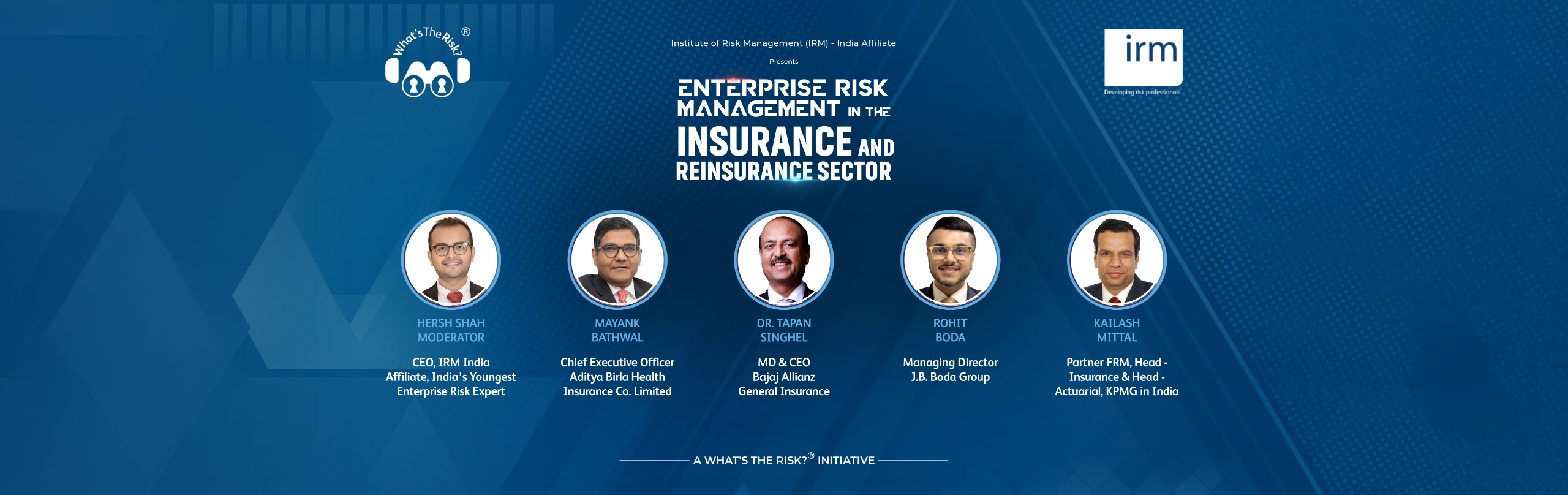
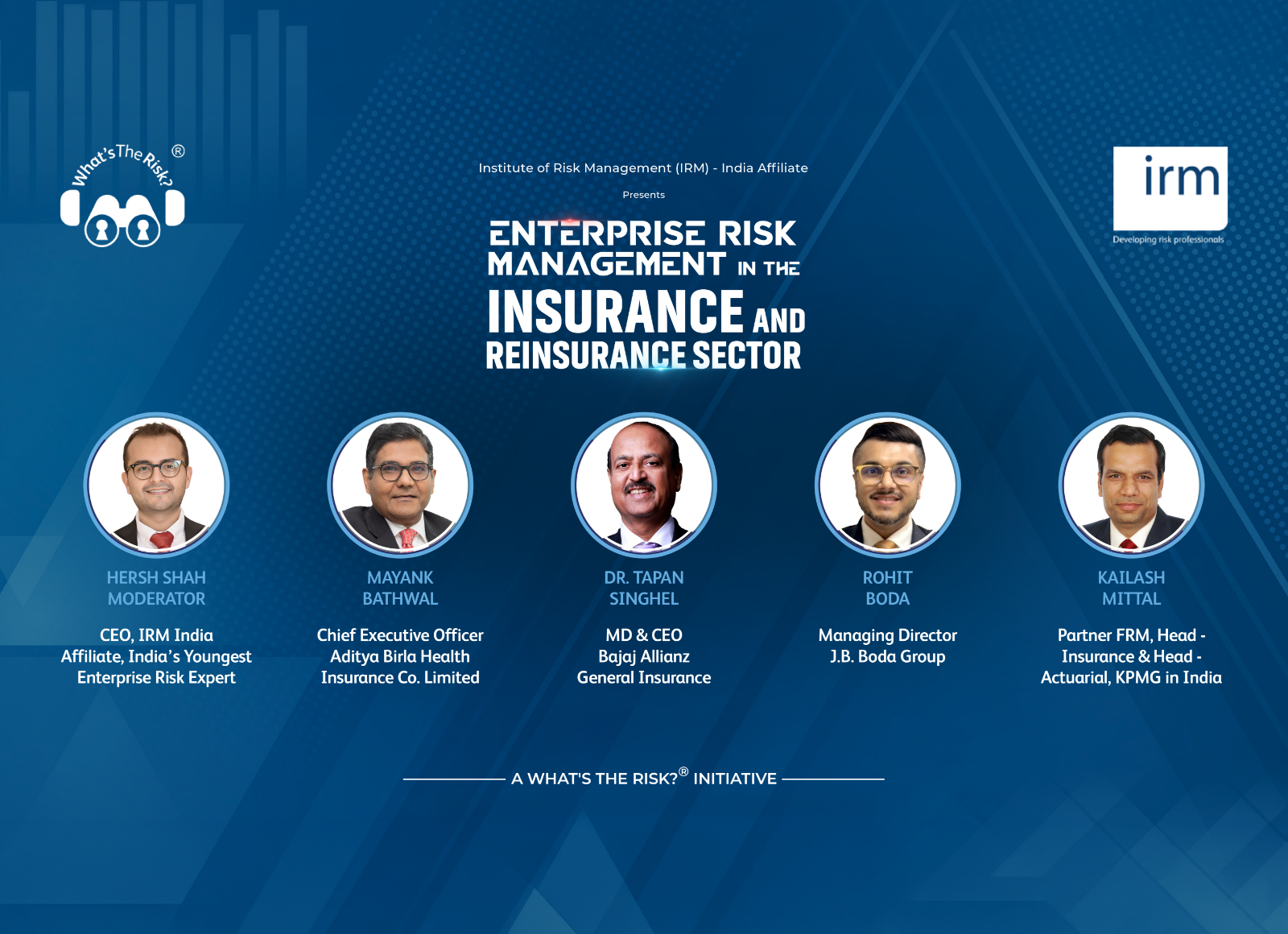


This article is the transcript of IRM India’s What’s The Risk?® episode telecast on CNBCTV18. The What’s The Risk?® initiative by IRM India Affiliate decodes risks and opportunities across diverse sectors with an objective of elevating the importance of risk intelligence and enterprise risk management as a skill, profession and business enabler.
Voiceover: Institute of Risk Management India Affiliate presents Enterprise Risk Management in the Insurance and Reinsurance Sector.
Hersh Shah:
A once in a century pandemic resets the actuarial tables. Sudden cloud bursts and floods append underwriting models within weeks. A single ransomware attack cripples an entire claims infrastructure, and a unicorn insurtech collapses amid valuation stress and governance lapses, shaking the overall investor faith. Now, these aren’t just hypothetical scenarios, they are real-world shocks that have tested the insurance sector’s resilience. They highlight a shift where risk is no longer a peripheral concern but a boardroom priority and a driver of business strategy. As insurers confront rising demands from regulators, shareholders, and even the society, the industry is undergoing a deep transformation. From capital adequacy and cyber risk, to climate exposures and trust erosion, the ground rules are rapidly evolving. Success now hinges not just on financial strength, but on cognitive and cultural agility. In this complex environment, enterprise risk management has become indispensable. It’s not merely about ensuring solvency but about enabling strategic foresight across regulatory change, pricing volatility, climate disruption, digital threats, and even shifting stakeholder expectations. So, here’s welcoming all of you to the panel discussion on Enterprise Risk Management in the Insurance and Reinsurance sector by the Institute of Risk Management India Affiliate. As the world’s leading certifying body for ERM exams across 140+ countries, the What’s The Risk?® initiative underscores our unwavering commitment to driving thought leadership in every sector and discipline. Joining me in today’s conversation are Kailash Mittal, Partner FRM, Head – Insurance & Head – Actuarial, KPMG in India, Dr. Tapan Singhel, MD & CEO, Bajaj Allianz General Insurance, Mayank Bathwal, Chief Executive Officer, Aditya Birla Health Insurance Co. Limited, and Rohit Boda, Managing Director, J.B. Boda Group. Gentlemen, thank you for participating in today’s episode. Kailash Mittal (Partner FRM, Head – Insurance & Head – Actuarial, KPMG in India), opening with you, how has enterprise risk management really matured within the Indian insurance and reinsurance sector over the past few years, and what are you seeing in terms of risk governance, or even, ownership beyond compliance, and even, board level involvement?
Kailash Mittal:
To put it in perspective, gone are the days where people would actually just look at the risk function as a pure tick-boxing exercise or a compliance activity. The way people now look at risk is to ingrain it as a part of decision-making on a day-to-day basis. CROs actually sit alongside the business owners, sit alongside the decision makers, if there is a trade-off that has to be done, whether it’s from entering into a new sales channel, whether it is launching a new product, relaxing underwriting norms, or, getting into any new product construct, testing waters, risk function holders or the CROs are at the core of it. To put it in perspective, instead of the question being asked to a CRO that what can go wrong, people are asking the question, if it goes wrong, how much will it go wrong by? What is the trade-off that I’m looking at? So, that risk reward trade-off in terms of, this is the upside against which there is a potential downside, that is how people are now evaluating various decisions, and this is a phenomenal change, Hersh, that we’ve seen at least in the last 5 to 10 years. Risk appetite is now coming at the core of it wherein different function holders are looking at what is the limit, what is the tolerance that they need to operate under. And that is how the businesses are evolving.
Hersh Shah:
I think that gives us a strong foundation of how the sector is positioned currently. Dr. Tapan Singhel (MD & CEO, Bajaj Allianz General Insurance), from your vantage point as a CEO of one of India’s largest general insurers, how are you seeing risk management enabling broader access, product integrity, and even, potentially long-term customer trust, especially in today’s volatile and tech-driven environment?
Tapan Singhel:
Let me give you a case in point. We had a war-like situation in India now, and you know in a war what actually happens, first, it would be the military sides, then the economic sides, and which actually puts a lot of industries closer to the west coast at greater risk in terms of a war-like situation or a war, which, if it had happened, would be a risk to them. How many industries are actually covered for war? The answer is next to zero. Had any CRO put that on before the war, in terms of the risk, and what are the mitigations that can take place? Either you set up your own kind of surveillance units to try and avoid any attack on that, or you take insurance with war cover. So, fundamentally, the point I want to make is, the next one is cyber, I think, again, if I look at all risk reports, are we really looking into cyber in a way that it should be? Potentially, the catastrophic event of cyber has not yet happened but people are foreseeing it’s going to happen pretty soon, which means huge loss to a lot of industries across, which will be coming in. So, we have risk coming to the center stage, but is it really being taken into that kind of seriousness is the question which should be there, and how are we really looking to put each of it into the mitigation form, or are we just picking up reports which would be available and putting it on? That is it. Progress has been made, is the next step which is there. Now, from an insurance company perspective, I think our obsession is risk management and also tools to mitigate risk. I think, as an industry, that is something which if you look at from our perspective, it will be there. And third is, to figure out new, evolving risks, and to see how we can protect and cover that, I think is something which will be there. So, for us, it is very inherent to keep on looking at all risks, studying every risk possible.
Hersh Shah:
You know, I’m very motivated to ask you a question around what is the amount of time that you would spend as a leader on risk-related discussions in the boardroom?
Tapan Singhel:
Yeah, see, if you look at it from a boardroom perspective, and that would be for the insurance industry, the regulator has actually stipulated, there’s a committee on risk. So, all insurance companies in India would have a risk committee, the CRO will be presenting to the board and discussions would happen on all of those points which are there. But the point is that you pick up each risk and see what can done to mitigate it, what can be done that if it happens, how do you avert it, and then go all out for it, and put a full team to see that you deliver on it on a consistent basis, and keep the slide on till it is over, till you have the next meeting and have clear action points. So, that is taken very very seriously from our perspective, and it comes naturally to us as insurers, fundamentally because we are in the business of risk.
Hersh Shah:
All right. Mayank Bathwal (Chief Executive Officer, Aditya Birla Health Insurance Co. Limited), let me bring you in here. What does it take to create a culture of risk awareness across a fast-growing health insurance organisation? We’ve spoken about general risk management practices, but how do you really align innovation, governance, and even, frontline decision-making under one cohesive ERM vision?
Mayank Bathwal:
Normally, in an organisation, you will say that minimise the risk, but, you know, as Tapan earlier said, we are actually in the business of risk, we are, in fact, in some sense, taking over risks of our customers onto our books, and therefore, risk is actually our business. And the way we then deal with this risk is not necessarily to minimise but to optimize the way we deal with these risks, and therefore, risk is not necessarily a vertical function which the CRO is running in an insurance business in general, and including a health insurance business that I have the opportunity to run. Because it is the job of every individual in the organisation, every senior leader has to understand what it would take to build a business where the risk that we are taking on onto our books is being managed effectively, and so, horizontal responsibility becomes an important part of risk management. Being part of a very large group, and most of the organisations who are running insurance businesses today for that matter are large brands, and therefore, there’s a large brand reputation issue also involved in the way you run your risk today. Therefore, that also comes as part of the overall governance framework that I’m sure each one of us are being kind of given as part of our promoter mandate as well, or shareholder mandate for that matter. So, like any other organisation, we have to have our own risk appetite in being in the health insurance business, which means that the right selection framework. We are encouraged as, or expected as a health insurance business to kind of provide health insurance to as large a mass of the Indian population as we can, which means that we are bringing in very different kinds of risks into a book, so, having the right product, having right underwriting capabilities. So, I think it’s something that, each organisation has to have its own strategy, but I think if you really innovate, as you said, it can give you an opportunity to create a much more meaningful and much more customer-friendly business model as well.
Hersh Shah:
Rohit Boda (Managing Director, J.B. Boda Group), coming to you. You’ve worked extensively in the insurance and reinsurance sector. Give us the landscape of mergers and acquisitions, especially in the broking space. What’s the current state, and what do you see as upcoming risks and opportunities for our viewers?
Rohit Boda:
If we draw ourselves back 10 years, mergers and acquisitions in the Indian broking space were unheard of, but the last decade saw a pandemic, which gave a huge boost to the insurance industry. Now, when you look at the distribution channel brokers, agents, with the growing number of brokers in the country, today, we are looking at 700+ brokers that are on the direct side of the reinsurance and composite combined. There’s a massive influx of capital in the broking community. We did not see the brokers from the emerged economies looking at the brokers from India, the private equity and the VC space, if you look at, did not look at broking as a lucrative asset to invest in, but now, if you again look at the last 36, 48, 60-odd months, it’s been a very interesting space where the investor sentiment towards the entire broking community has changed. One of the major reasons is of course, penetration and the valuations that the broking community offers, but it’s a very long-term play. We’re looking at not the 5 year or 10 year horizon, but for the next 25 years, broker consolidation is a reality, and the foreign brokers investing in the Indian entities is of course, a huge risk not only from the business perspective but cross border liabilities, and we’re looking at the M&A liabilities in itself from the tax perspective. So, the merger and acquisition space in the broking, be it insurance or reinsurance, is here to stay. So, there’s a lot of exciting things happening in the broking space, so, we have to see how the acquisitions go.
Hersh Shah:
Alright. We’ll take a short break now. Coming up, we’ll discuss capital resilience, leadership accountability, and even how India’s insurers are reimagining their strategies for a rapidly shifting risk landscape. Stay tuned, we’ll be right back.
Voiceover:
Institute of Risk Management India Affiliate presents Enterprise Risk Management in the Insurance and Reinsurance Sector.
Hersh Shah:
Welcome back to the eighth episode of IRM India’s What’s the Risk?® initiative, Enterprise Risk Management in the Insurance and Reinsurance Sector. I’ve been in conversation with Kailash, Dr. Tapan, Mayank and Rohit. Kailash, let me bring you back in again. With IFRS 17 and risk-based capital norms approaching, what are some of the practical ways that Chief Risk Officers and actuaries should collaborate on integrated forward-looking risk intelligence?
Kailash Mittal:
Going forward, the boundaries will start blurring. You will not really have an actuarial function, a finance function or a risk function, right. You could have experts, but people will have to start understanding each other’s language. To put it in perspective, a chartered accountant will have to understand what an actuary focuses on, and an actuary will have to understand the accounting elements, a risk professional will have to see the accounting part of it, the actuarial part of it, and also connect the dots with the investments team. So, what we will see is a cross-pollination of sorts, wherein we’ll be running after talent, we’ll be running after individuals who understand and have an ability to speak the language of actuaries, chartered accountants, risk professionals, investments, and so on and so forth. And when we see IFRS 17, and Economic Capital, or Solvency 2 having been rolled out overseas, this is what we are seeing as a change in actuarial function holder’s capacity, the Chief Actuary’s capacity, the CFO’s capacity, and so on and so forth. So, this is what we are actually seeing transpire, and the teams transform to this level, and that’s something, it is only a matter of time before it starts happening in the Indian environment as well. As a practical approach, one suggestion, and then that is something that we’ve seen, is to do a cross-pollination of talent, right. So, start shifting people from finance functions to actuarial, vice versa, do a cross-pollination with investments, with risk functions, such that any individual who has come up the ladder, who is actually sitting at the table to take decisions, has had an exposure across various functions, right. So, that helps, having a well-rounded personality, well informed decision making, which will inform and be in the best interest of the entity.
Hersh Shah:
Those are some great points. Dr. Singhel, we just concluded an episode on polycrisis. So, I want to understand from you when multiple systemic risks collide, how do you think insurers should build agility into their response systems without losing the long-term focus?
Tapan Singhel:
See, the issue is if we look at insurers, they always work on modelling, model of a catastrophic event that happened, or they’ll model if a black swan event happened, then they’ll put in about 8-10 different models, they’ll try to also put in scenarios in which couple of them will trigger together, and do a stress test analysis to see what can be done, and how it can be handled. So, I think that is what most insurers do, and that’s how they get prepared, and the model also keeps evolving. So, if I look at a model, let us say for floods 10 years back, and when I look at a model today, it has evolved considerably. And if you look at weather based events, they have changed a lot, you also had a COVID kind of scenario which had not been modeled earlier, you also have supply disruption happening now in different places, so, the models keep on evolving, it’s a continuous process. I think we have a lot of global experts, local experts, all put together, and they work on this to see how it can be best attuned. One thing is, working models to see different standards, to see how do you react, how do you deliver the best to your customers, and how do you also make customers aware, that is also a bigger issue.
Hersh Shah:
Mayak, continuing our previous conversation on risk culture. You know, in my interaction with Chief Risk Officers, I often see that board-level buy-in is a big challenge. So, how do you engage the board and shareholders on driving the strategic value of ERM, not just as a protective layer but more as a competitive enabler and even, a confidence builder?
Mayank Bathwal:
At the board level, there are two categories of discussion that typically happen, as far as risk management is concerned. One is, as we heard earlier, as a regulated entity we have this whole mandate of having a risk management committee, risk management conversations, not only in the core board process but also as a separate subcommittee of the board, and there we have experts who come from the area of risk, who not only work with the management team but also guide them in terms of bringing their experience to the table. So, one is the conversation of what the regulation requires you to do, which is to some extent, probably will be part of the protective layer that you spoke about, in terms of are they risks that you are expected to take care of as an entity which is regulated, and as an entity which must be solvent, because finally we are only promising benefits to our customers, so, what the regulator will be very very keen to ensure is that we remain a solvent entity. So, there are issues and conversations that happen around that, but I think the other point that you made is very important, which is about using risk as a strategic tool to build competitive moats and competitive advantage in a hyper-scale, hyper-competitive industry that we are part of, or it will become even more competitive in times to come. Let me give you a couple of examples here. Now, data is available for organisations who really put in investments to kind of get to know their customers more, their other stakeholders better, their business better. How are you using data to build an ability to be able to, let’s say, deal with the risk much more effectively? Whether it’s risk in your core business, which is the business of risk that we are in, let’s say, taking on the health risk of our consumers, or even, to take care of emerging risks in areas like cyber, and other areas of risk that might kind of impact business in a negative fashion if we’re not ready. So, that’s one part of it. Second is, can you use that data to price in offerings, and benefits, etc.? That gives you an ability to take on risks in the business, which your competitors may not be able to do. But, I think risk has become very integral and highly embedded into the organisation, and therefore, these conversations in boardrooms are very strategic in nature.
Hersh Shah:
Alright. Rohit, from a capital markets perspective, what are the challenges that you see for the reinsurance sector? What are the opportunities that you see for the sector?
Rohit Boda:
In the emerging economies, or if you look at a country like India, which is now a trillion-dollar economy and one of the largest insurance markets, and growing, if in a growing insurance market, risk has to be managed over a long time, over a long term, or over a long period, then, only reinsurance is never going to be the solution. It is the involvement of the capital market, the joining of hands of the insurance and the capital market regulator, which is of crucial importance. Now, when I use the jargon capital markets, I don’t mean listing of the entities onto the stock market. What we are talking about here is an absolute transfer of the risk to the capital markets. Now, I’m quite sure that the nation is not aware of what reinsurance is, because it’s a very behind the camera kind of a business fraternity, but there’s also a whole world of transfer of risk to the capital markets, where there are cells, there are side cars, SPVs, and vehicles created, where investors invest money, and then, there are returns through the management of the vehicle in itself. Today, if we look at, again, any emerging economy, climate, cyber, or the next pandemic as we call it, how are you going to mitigate this? How are you going to control? You cannot control but how are you going to manage the risk that is going to arise out of it? Most importantly, the role of the risk managers in not letting their balance sheets be burnt. Now, reinsurance comes in, of course, as handy insurance, as the largest risk transfer mechanism. The Indian investor is heavily relied on 3 or 4 asset classes, again, gold, equity, real estate, and then because of the large 1.4 billion population, we’re looking at investors looking at D2C brands now because of the internet and awareness. But, again, they’ve never looked at insurance or reinsurance as an asset class. There are ways and methods, if you look at the western world, or the emerged economies globally, again, we’re looking at 3-4 decades back when the first structuring of these kind of risk transfer products happened. In India, or in any emerging market, this is very unheard of, but in no time, probably we’re looking at a horizon of next 3 to 5 years when these kind of products will come. Yeah, so, that’s how we look at it, because only relying on reinsurance as a market, because reinsurance again gets reinsured through transfer of risk.
Hersh Shah:
Well, that brings us to the end of a high-stakes and deeply insightful dialogue. I think today’s conversation reinforces a vital truth, that the insurance and reinsurance sectors are no longer simply about risk transfer, they’re really emerging as strategic platforms for resilience, innovation, and even, long-term value creation, as the panelists said. So, whether it’s underwriting climate volatility, navigating capital reforms, or even, responding to a digital disruption, the industry is being redefined at its core. Reinsurers, in particular, are stepping up, not just as global risk absorbers but as partners in systemic risk foresight, and helping insurers and economists stay ahead of cascading threats. In this evolving landscape, Enterprise Risk Management is no longer a back-end discipline, it’s fast becoming the front line of leadership, one that calls for sharper foresight, deeper collaboration, and even, the ability to turn complexity into clarity. Thank you, Kailash, Dr. Tapan, Mayank, and Rohit for really helping us explore this transformational journey with such depth and clarity. Stay tuned for the next episode of What’s The Risk?® as we continue decoding the shifting architecture of enterprise resilience across sectors and across borders.
Voiceover:
Institute of Risk Management India Affiliate presents Enterprise Risk Management in the Insurance and Reinsurance Sector.