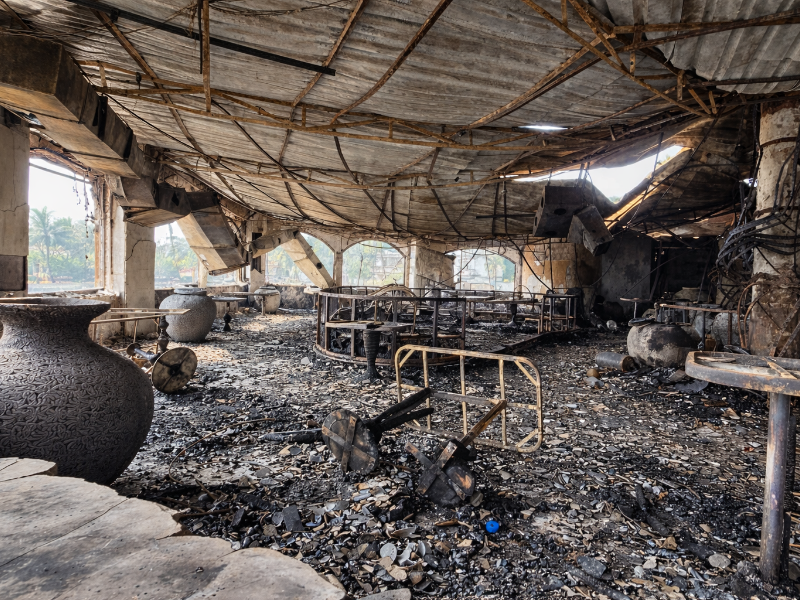
In the realm of risk management, COP 28 unfolded as a pivotal chapter, presenting the quintessential challenge of our era – the narrative of climate change. Numerous media outlets highlighted positive achievements; however, these accomplishments, such as explicitly naming fossil fuels in the COP agreement, tripling investments in renewable energy, and establishing a Fund for Loss and Damage, were necessary responses rather than sufficient solutions. The imperative has shifted beyond risk management; now, prevention is paramount.
Examining the agreement reveals an inadequacy in securing emissions reductions to limit global warming to the ambitious 1.5°C target of the Paris Agreement. Despite the call for faster cuts, most countries’ submitted targets fall short. We have transitioned from climate change denial to a perilous era of climate action delay.
A risk professional’s perspective decomposes the risk of an event into severity and probability of occurrence. Global leadership’s approach to climate change either reflects an underappreciation of the severity beyond the 2-degree threshold or a total disregard for a 100% probable event. The consequences of procrastination manifest in ecosystem erosion, increased extreme weather events, and rising sea levels.
Climate change, with its zoo of risks, demands a sophisticated, comprehensive approach. It extends beyond an environmental concern, intertwining economic, social, and geopolitical risks. While events and their outcomes rarely have 100% probabilities, breaching the 1.5-degree threshold without preventative action is a very real and probable scenario.
Urgency demands robust policies aligned with the gravity of the climate crisis. Leaders must act as catalysts for meaningful change, transcending traditional boundaries. As risk professionals, our role extends to stewardship of a sustainable future, advocating for discernment in a world inclined towards risk management over prevention.
The Tools We Can Lend
In the course of my studies at INSEAD business school, we were taught the power of visualisation. As you might imagine, a room of executives-in-training often scoffs at what they call “fluffy” pedagogy that seemingly leaves wanting for scientific robustness and applicability, but this technique, introduced during an Ethics course, struck a chord for many. The purpose was to introduce a method that would facilitate apt appreciation when faced with dilemmas and choices that, though immediately, had no emotional weight, would one day in the future, for other generations.
For many risk managers this is nothing new, and rather a rebranding of simulation or scenario analysis. What we may have missed however, is the emotive power of this more human equivalent. Ask any good marketer, and they will tell you the most powerful advertisements are the most emotive. Our system 1 thinking is largely emotional and literal, our system 2 is prone to counter even the most reasonable of arguments, simply because we do not like to be manipulated. The use of this technique allows us to engage wholeheartedly with the threat of climate change and override the urge to justify or delay.
Visualisation is not the only powerful risk professional tool at our disposal. Part of the driver for the weakness of the COP 28 agreement is quite simply: Money. Robust policy generally requires someone to pay. Either to pay upfront or pay in opportunity costs. From behavioural economics, we know our association of Money with Power means most of us, at all levels of society, struggle with giving ample amounts away. Unfortunately this continues to restrain our willingness for funding much needed transition. However what marketeers have learnt is the act of “payment decoupling”. Talk less about what is being paid; and more about what is earned. Or alternatively, talk more about what is at stake: sound familiar? This is simply no more than a Value-at-Risk or VaR measure.
We do not confront enough the economic cost of delay. We talk in statistical terms. We have not made the purchasing and production of actions that take us away from our goals, financially painful enough. This doesn’t even have to be done with economic resources. Equally successful are psychological methods, such as the 5c plastic bag charge, that saw usage fall in Singapore, one of the world’s richest countries, by around 80%. What most people realise however, is the role of the consumer is fairly small. Changing habits is important, but more significant are the habits of producers and the largest economic actors and industries.
Finally, the most impactful risk tool we can lend to COP 28 delegates? Action. There is no risk manager that is confronted by a limit breach, event occurrence or regulatory misdemeanour that ignores it. The series of events that follows any such happening, or even a 90% flag that we are approaching one, starts with action. Immediate action. Simply explaining “how we allowed this to happen” comes after, what comes first is an aggressive campaign to undo or mitigate what has happened.
We must urge and encourage those who can, to act.
The aftermath of COP 28 exposed a continued reliance on risk management for climate change, prioritising mitigation despite the inevitability of a severe and 100% likely event based on current actions. Our collective responsibility is to champion prevention over management, forging a path toward a resilient and sustainable future.
Blog Author: Kudirat Olateju, INSEAD MBA Candidate and Chemical Engineering Masters graduate from Imperial College