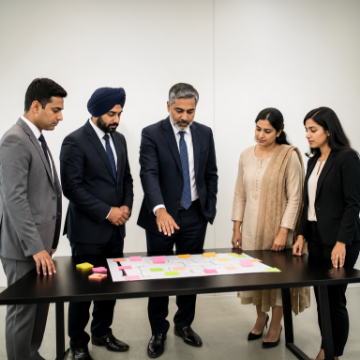




Every year, Guru Purnima reminds us to pause and express gratitude to those who have shaped our thinking, influenced our decisions, challenged our assumptions, and helped us become better versions of ourselves. Traditionally, the word Guru evokes the image of a teacher, mentor, coach or guide—someone who possesses knowledge and generously shares it with others. Yet, in today’s organisations, perhaps the greatest opportunity lies not in looking for one guru, but in recognising that every individual has the potential to be a guru in at least one area.
This shift in thinking is particularly relevant in an era where organisations are navigating unprecedented uncertainty. Enterprise risks today are no longer confined to finance, operations or compliance. They stem from talent attrition, knowledge concentration, changing technologies, misinformation, cyber threats, evolving customer expectations, geopolitical disruptions and cultural fragility. Organisations are increasingly discovering that resilience is not simply about having stronger systems or better policies. It is fundamentally about people.
A resilient organisation is built when knowledge is distributed rather than concentrated, when expertise is celebrated rather than hidden, and when employees see themselves not merely as task executors but as contributors to the growth of others. This is where the concept of a Guru Badge, invented by Hersh Shah, CEO, IRM India Affiliate and India’s Youngest Enterprise Risk expert becomes remarkably powerful.
Imagine asking every employee one simple question:
“What is the one thing you are the guru of within your team?”
Not their designation. Not their years of experience. Not the number of people reporting to them. Simply the one capability, behaviour or expertise that others consistently seek them out for.
For one person, it may be stakeholder management. For another, financial modelling. Someone may be the guru of customer empathy. Another may be the guru of presentation design. Someone may possess exceptional crisis management skills. Another may be known for simplifying complex regulations.
Some may be masters of relationship building. Others may consistently identify risks before they become problems. Every employee possesses a form of wisdom that deserves recognition.
The Guru Badge simply gives that wisdom a visible identity. While this may initially appear to be an employee engagement initiative, its strategic implications extend far beyond recognition. It becomes an organisation-wide resilience mechanism.
One of the greatest organisational risks is the concentration of knowledge. Critical expertise often resides with a handful of individuals. Processes become dependent upon specific employees. Relationships exist inside someone’s personal network. Institutional memory remains undocumented. When these individuals resign, retire, become unavailable or simply move to another role, organisations frequently discover that they have not merely lost an employee—they have lost years of experience, judgment and contextual understanding.
Traditional succession planning attempts to address this challenge from the top down. Guru Badges approach the same challenge from the bottom up.
Rather than identifying only future leaders, organisations identify everyday experts. The person who always resolves IT issues. The individual who knows every procurement nuance. The colleague who can calm an angry customer. The finance executive who spots inconsistencies others overlook. The HR professional who instinctively senses cultural concerns before they escalate.
Each of these individuals represents a critical node in the organisational knowledge network. By formally recognising their expertise, encouraging them to teach others and documenting their practices, organisations begin reducing key-person dependency—one of the most overlooked operational risks. This directly strengthens organisational resilience. The Guru Badge also transforms organisational culture.
Many workplaces unintentionally reward information ownership rather than information sharing. Expertise becomes a source of job security. Employees often believe that if they become the only person capable of performing a particular task, they become indispensable. While understandable, this mindset creates knowledge risks and fragile organisations.
Resilient organisations operate differently. Their strongest employees are not those who know the most. They are those who multiply knowledge. The Guru Badge changes what organisations celebrate. Instead of rewarding employees solely for individual performance, it recognises those who elevate collective capability. Knowledge sharing becomes prestigious. Teaching becomes leadership. Mentoring becomes a measurable contribution.
Employees no longer ask, “What do I know?”
They begin asking, “What can I teach?”
That subtle change in mindset fundamentally alters organisational behaviour. The impact extends into innovation as well.
Research consistently demonstrates that innovation emerges through the intersection of diverse expertise rather than isolated brilliance. When organisations prioritise knowledge management and make individual strengths visible through Guru Badges, they create an internal marketplace of expertise.
Marketing begins learning from finance.
Operations learn from customer service.
Legal learns from technology.
Risk professionals learn from behavioural psychologists.
Human resources learn from data analysts.
Knowledge starts flowing horizontally instead of remaining trapped within departmental silos.
This cross-functional learning significantly enhances an organisation’s ability to respond to emerging risks because modern risks rarely remain confined within one department.
Cybersecurity affects legal.
Climate risks affect finance.
Supply chain disruptions affect customer experience.
Artificial intelligence affects governance.
Reputation risks affect everyone.
A workforce accustomed to learning from one another naturally becomes more adaptive during periods of disruption.The Guru Badge also contributes to psychological safety. Many employees hesitate to share ideas because they believe expertise belongs only to senior leadership. Recognition through Guru Badges democratises expertise. It communicates a powerful message:
“You do not need a senior designation to possess valuable knowledge.”
When employees feel that their expertise is recognised irrespective of hierarchy, they become more willing to contribute ideas, challenge assumptions and proactively practice risk identification. This has profound implications for enterprise risk management. One of the recurring findings across major corporate failures is not that risks were invisible, but that people saw them and remained silent.
Sometimes they feared being wrong. Sometimes they assumed someone senior already knew. Sometimes they believed their opinion did not matter. A culture where everyone is recognised as a guru in something creates greater confidence to speak up, thereby reducing the instances of incidents related to human capital risks.
Employees begin believing:
“My expertise has value.”
“My perspective matters.”
“If I notice something unusual, I should say it.”
That is precisely the behaviour resilient organisations require.
The Guru Badge also strengthens learning agility.
Historically, organisational learning has been delivered through structured training programmes designed and facilitated by a select group of instructors. While these programmes remain essential, they often overlook one of the richest sources of knowledge available—the employees themselves.
Imagine every Guru Badge holder conducting one 20-minute knowledge session every quarter. Imagine short internal videos. Peer mentoring circles. Problem-solving clinics. Office hours. Micro-learning libraries. Within a year, hundreds of practical learning moments emerge organically without significant additional investment. Knowledge becomes continuous rather than event-based. Learning becomes social rather than formal. Expertise becomes visible rather than assumed.
Perhaps most importantly, Guru Badges strengthen organisational identity. Employees increasingly seek meaning in their work beyond salary and designation. Being recognised as “the negotiation guru,” “the resilience guru,” “the compliance guru,” “the customer experience guru,” or “the innovation guru” creates a professional identity anchored in contribution rather than hierarchy.
Identity influences behaviour.
People naturally protect identities they value.
Someone recognised as the quality guru becomes more vigilant about quality.
The ethics guru consistently reinforces integrity.
The customer guru champions service excellence.
Recognition therefore becomes a behavioural reinforcement mechanism.
From a risk management perspective, this is extremely valuable because culture is ultimately shaped through repeated behaviours rather than written policies.
Organisations can even integrate Guru Badges into enterprise risk frameworks.
Alongside identifying risk owners, organisations can identify knowledge owners.
For every critical risk category, there should ideally be recognised internal gurus.
- Cyber Guru.
- Data Privacy Guru.
- Business Continuity Guru.
- Customer Trust Guru.
- Supply Chain Guru.
- Compliance Risk Guru.
- Ethics Guru.
- Artificial Intelligence Guru.
- Climate Risk Guru.
- Project Governance Guru.
- Cultural Risk Guru.
These individuals need not own the risk formally. Instead, they become accessible internal experts who continuously elevate organisational capability in their respective domains. This creates distributed risk resilience. Instead of relying solely upon central risk teams, resilience becomes embedded across the organisation. The symbolism of Guru Purnima makes this initiative even more meaningful.
Traditionally, Guru Purnima is about expressing gratitude towards those who illuminate our path. In organisations, that light often comes from unexpected places. The colleague who patiently explains a complex spreadsheet. The receptionist who knows how to calm anxious visitors. The IT executive who prevents crises before they occur. The administrator who always anticipates logistical challenges. The project manager who sees risks weeks before everyone else. The finance executive who protects organisational integrity. The communications professional who preserves reputation during uncertainty. These individuals may never receive awards for revenue generation or business development, yet they quietly strengthen organisational resilience every single day.
Recognising them through Guru Badges sends a profound message:
Teaching matters.
Sharing matters.
Experience matters.
Wisdom matters.
And perhaps most importantly, everyone has something worth teaching.
As organisations prepare for an increasingly uncertain future, competitive advantage will not belong solely to those with the most advanced technologies, the largest budgets or the strongest brands. It will belong to organisations capable of learning faster than change itself. Such organisations understand that operational resilience is not built only through frameworks, dashboards, controls or policies. It is built through people who willingly teach, willingly learn and willingly strengthen one another.
Guru Purnima therefore offers a timeless lesson for modern enterprise risk management. Every employee is someone’s teacher. Every individual carries unique knowledge. Every conversation has the potential to transfer resilience. The question organisations should begin asking is no longer, “Who is our Guru?” Instead, they should ask, “What is every employee the Guru of – and how do we help that wisdom become everyone else’s strength?”
That single question has the potential to transform not only learning and development, but also organisational culture, enterprise risk management and long-term resilience. In a world where uncertainty is becoming the norm rather than the exception, the organisations that recognise the teacher within every individual may well become the organisations that endure, adapt and thrive in the face of uncertain risks.
FAQS:
1.What is the main purpose of celebrating Guru Purnima?
- Traditionally, the word Guru evokes the image of a teacher, mentor, coach or guide—someone who possesses knowledge and generously shares it with others.
- Every year, Guru Purnima reminds us to pause and express gratitude to those who have shaped our thinking, influenced our decisions, challenged our assumptions, and helped us become better versions of ourselves.
2. Why is it important to share knowledge in the workplace?
- One of the greatest organisational risks is the concentration of knowledge.
- Critical expertise often resides with a handful of individuals. Processes become dependent upon specific employees. Relationships exist inside someone’s personal network. Institutional memory remains undocumented. When these individuals resign, retire, become unavailable or simply move to another role, organisations frequently discover that they have not merely lost an employee—they have lost years of experience, judgment and contextual understanding.
- Each of these individuals represents a critical node in the organisational knowledge network. Many workplaces unintentionally reward information ownership rather than information sharing. Expertise becomes a source of job security. Employees often believe that if they become the only person capable of performing a particular task, they become indispensable. While understandable, this mindset creates fragile organisations.
- By formally recognising their expertise, encouraging them to teach others and documenting their practices, organisations begin reducing key-person dependency—one of the most overlooked operational risks. This directly strengthens organisational resilience.
3. What is the definition of knowledge management?
- Knowledge management is the structured process of identifying, capturing, organising, sharing and applying an organisation’s collective knowledge so that expertise does not remain with a few individuals or disappear when employees leave. It includes both explicit knowledge—such as documented procedures, templates and training material—and tacit knowledge, such as experience, judgement, relationships and practical know-how.
- Knowledge management improves cross-functional learning and helps organisations respond to risks that affect multiple departments, such as cyber, climate, supply-chain and reputational risks.
- The Guru Badge is a practical knowledge-management mechanism. It helps an organisation identify what each employee is recognised for, make that expertise visible and create channels through which it can be transferred to others. This is especially important where critical processes, relationships and institutional memory are concentrated in a small number of people, creating key-person dependency and operational risk.