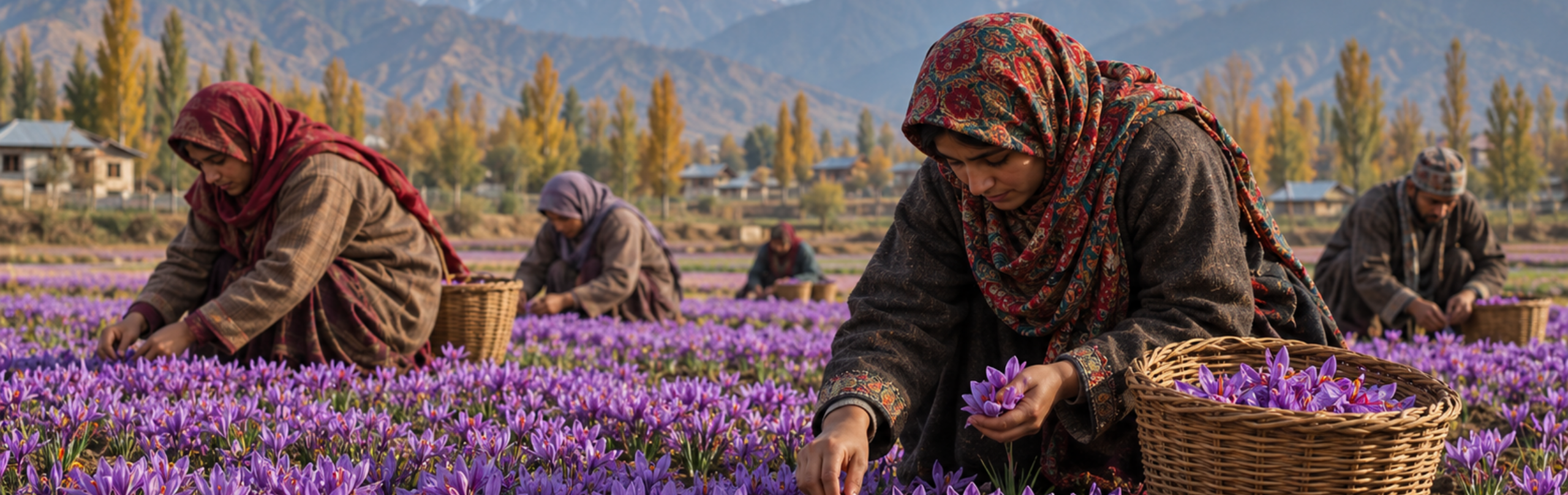
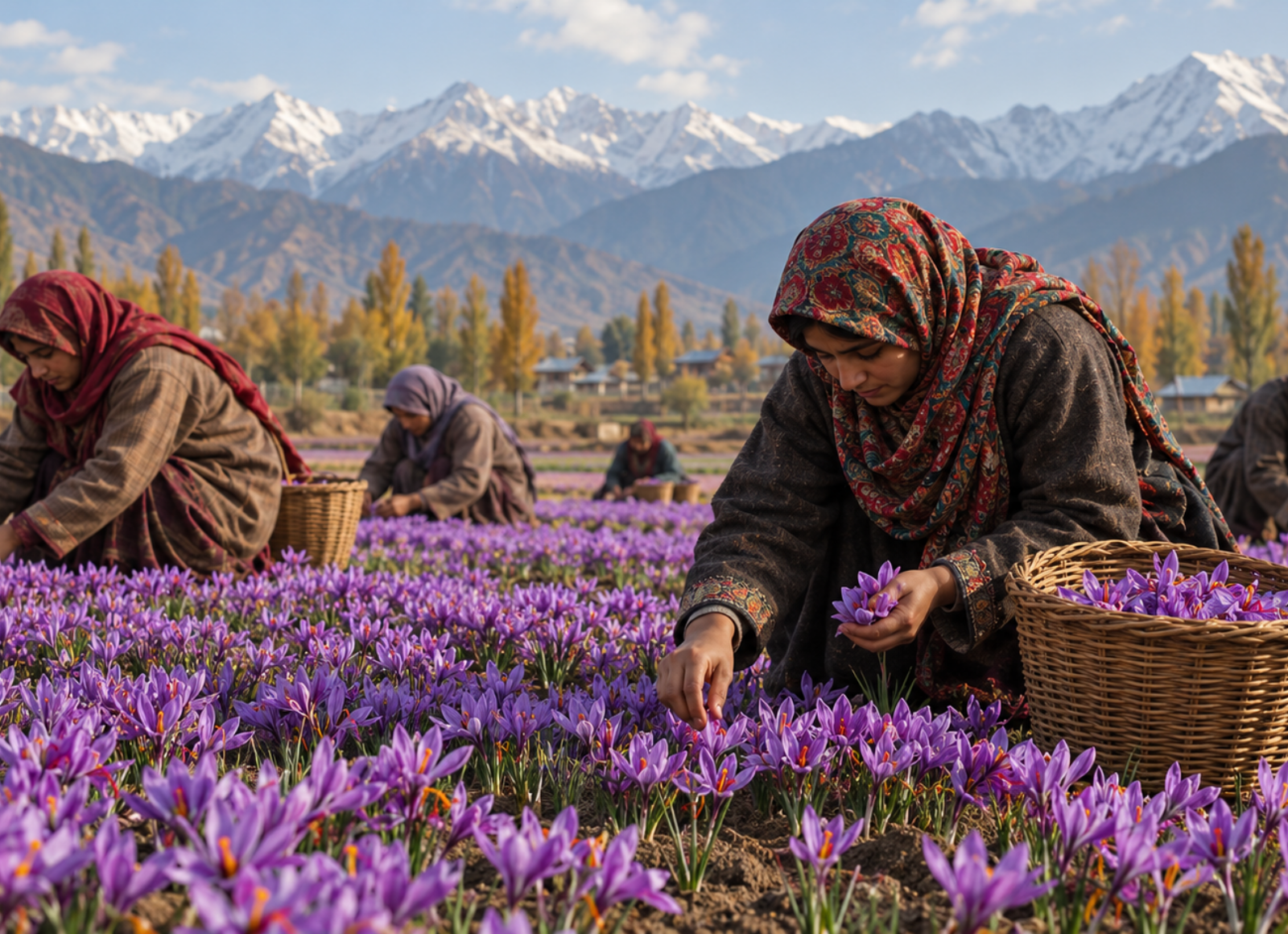
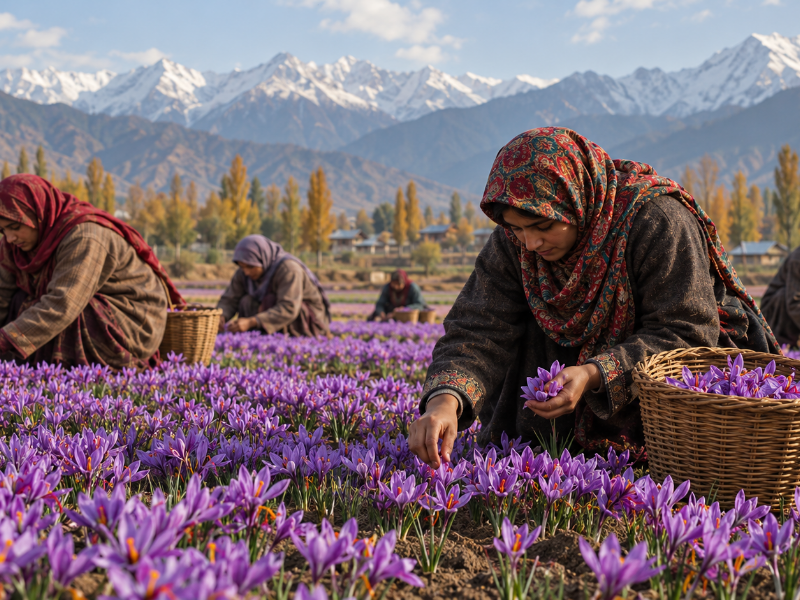


Few agricultural products concentrate as much value, heritage and vulnerability into as little physical volume as saffron.
Each crimson thread represents an unusually complex chain of biological propagation, seasonal flowering, manual harvesting, stigma separation, controlled drying, laboratory grading, origin certification, storage and trade. A failure at any stage may create business risk and diminish not only the value of a batch but also the credibility of Kashmir saffron as a geographical indication and India’s position in the premium spice economy.
That makes saffron more than a high-value horticultural commodity. It is an interconnected risk ecosystem involving growers, corm nurseries, processors, laboratories, traders, exporters, food businesses, regulators, e-commerce platforms, financial institutions and consumers.
The principal risk is not simply that India may produce less saffron. It is that declining production, imported supply, weak provenance controls, uneven laboratory assurance and climate volatility risk may combine to make genuine Indian saffron harder to distinguish, finance and commercialise.
The business of “red gold” therefore requires a transition from crop-development programmes to real-time risk monitoring and integrity management across the entire value chain.
A Precious Crop Carrying an Unpriced Risk Premium
Kashmir saffron received geographical indication registration in May 2020. The registration, held by the Agriculture Production Department of Jammu and Kashmir, remains valid until December 2028. Kashmir’s saffron landscape has also been recognised as one of India’s Globally Important Agricultural Heritage Systems. These designations create significant intellectual-property, cultural and market value. They do not, however, automatically authenticate every packet sold as “Kashmiri saffron.” [1] [2]
A geographical indication protects the relationship between product, place and reputation. Its commercial value depends on whether authorised production can be traced from a qualifying field to a sealed retail unit.
This distinction is important because saffron’s risk profile is multiplicative; several risks interact and can amplify one another. Production volatility can create supply shortages, while unclear origin and quality variations make saffron authenticity difficult to verify. Because saffron is expensive, these uncertainties increase the incentive for fraud, and delays in testing or detection can allow problems to move through the supply chain. Thus, the overall risk is shaped not by one factor alone, but by the combined effect of production, traceability, quality, fraud, and control delays.
When any factor rises sharply, the integrity of the entire ecosystem may deteriorate. A poor harvest may increase prices and encourage substitution. Weak segregation may permit imported product to enter domestic-origin channels. Delayed testing may allow suspect material to be blended or distributed before laboratory results are available.
The strongest defence is therefore not a single certificate or inspection. It is a connected system of controls capable of preserving geographic and commercial identity while keeping biological risks at bay.
Biological concentration turns corm health into systemic risk
Crocus sativus is a sterile triploid plant. It does not reproduce through conventional seed multiplication and must be propagated vegetatively through underground corms.
This biological characteristic creates a structural risk. Where corms are repeatedly sourced from related or poorly monitored material, pathogens, physical defects and declining vigour may spread through successive production cycles. Genetic uniformity also limits the crop’s ability to adapt naturally to changing environmental pressures.
Corm rot is therefore not an isolated farm-management problem. It is a supply-chain biosecurity risk.
A 2025 study from Kashmir reported the first confirmed Indian identification of Fusarium acuminatum as a cause of saffron corm rot using pathogenicity testing and multigene sequence analysis. Earlier research across Jammu and Kashmir found several potentially pathogenic fungal genera in saffron fields and concluded that physical injury to corms was a critical precondition for disease development in the tested isolates. [3] [4]
This changes the control logic. Crop disease management cannot rely solely on fungicide application after visible symptoms emerge. It must address the interaction between:
- infected or unverified planting material;
- mechanical injury during lifting, sorting and replanting;
- monoculture and soil pathogen accumulation;
- drainage and soil-moisture conditions;
- storage hygiene;
- delayed field-level disease detection.
A robust biosecurity system would assign every corm lot a unique identity, record its nursery and field history, inspect it before distribution and quarantine suspect material. Field-level disease incidence should be geospatially mapped, while corm handling procedures should be engineered to minimise wounds.
The announcement in 2025 of a proposed tissue-culture laboratory and nursery for Kashmiri saffron could strengthen this control environment, provided the initiative is linked to pathogen-indexed planting material, nursery accreditation, corm-lot traceability and post-distribution surveillance. Tissue culture should not be treated merely as a production intervention. It should become part of a certified biological assurance system. [5]
When Weather Becomes Working Capital Risk
Saffron’s flowering cycle is highly sensitive to the timing of temperature and moisture. Irrigation failure, prolonged dryness, unseasonal rainfall or abnormal heat during critical crop stages may affect flowering, stigma development and final yield.
Recent reporting, citing government data, indicated that saffron production in Jammu and Kashmir declined from approximately eight metric tonnes in 2010–11 to 2.6 metric tonnes in 2023–24. Rising temperatures, erratic rainfall, urbanisation and pressure on traditional cultivation areas have contributed to concern about the resilience of the sector. [6]
For growers, this is an income and livelihood risk. For traders, processors and brands, it becomes a procurement, working-capital and price-volatility risk. For lenders, it affects repayment capacity and collateral assumptions. For the geographical indication, a persistent supply contraction may increase incentives to pass imported, mixed or adulterated material off as Kashmir-origin saffron.
Climate risk should therefore be translated into operational and financial indicators rather than described only as a long-term environmental issue.
A climate risk model for saffron production should monitor:
- accumulated rainfall and soil moisture before flowering;
- minimum and maximum temperature deviations;
- irrigation-system functionality;
- flowering density by plot;
- corm mortality and rot incidence;
- land-use conversion within saffron-growing zones;
- expected yield variance;
- projected procurement and price gaps.
Controlled-environment and indoor cultivation are being explored in Kashmir as potential responses to weather variability. Such systems may reduce exposure to rainfall and temperature shocks, but they introduce new risks: capital intensity, energy dependence, humidity control, disease concentration, technical failure and questions concerning quality equivalence and GI eligibility. [6]
Indoor cultivation should consequently be treated as a portfolio hedge and research pathway, not an automatic replacement for field cultivation. Before commercial scaling, its output should be tested for crocin, picrocrocin, safranal, moisture, sensory profile and consistency. Its conformity with GI specifications and authorised production practices should also be formally assessed.
India’s Saffron Trade Contains an Origin Paradox
Trade data reveals a critical risk that conventional production analysis may overlook.
Under the HS 091020 customs classification, India imported approximately 58,009 kilograms of saffron valued at US$37.65 million in 2024. Afghanistan accounted for about 50,169 kilograms; more than 86% of reported import volume. India also reported exporting approximately 10,193 kilograms of saffron valued at US$3.61 million during the same calendar year. [7]
These figures should be interpreted cautiously. Customs data and domestic production statistics cover different periods and do not establish product grade, end use, stock movements, re-exporting or geographic origin within India. They do, however, demonstrate why “exported from India” cannot be treated as synonymous with “Kashmir saffron.”
The data also indicates a substantial imported-supply ecosystem operating alongside relatively limited domestic production. That is not evidence of misconduct. It is evidence of provenance risk.
Imported saffron may be legally processed, packaged, consumed or re-exported in India. The operation risk arises when origin streams are inadequately segregated or when labels, digital listings and marketing language create the impression that imported product is GI-certified Kashmir saffron.
Concentration creates another exposure. Afghanistan represented close to 90% of the value of India’s reported saffron imports in 2024. Recent disruption of Afghan trade through traditional routes, followed by greater use of Iranian and Central Asian corridors, illustrates how border closures, transit restrictions, freight costs and regional instability may affect continuity. [8] [9]
Importers and processors should therefore assess not only supplier quality but also:
- origin-document reliability;
- transport-route concentration;
- sanctions and payment exposure;
- border and customs delays;
- cargo insurance;
- temperature and moisture conditions in transit;
- substitution risk during shortages;
- supplier financial resilience.
A mandatory mass-balance control should reconcile opening stock, verified purchases, imports, exports, domestic sales, and closing stock to identify any unexplained variance. Any unexplained variance above a defined tolerance should trigger an investigation into possible financial risk – recordkeeping errors, losses, diversion, or misclassification etc. This control is especially important when the same entity handles both imported saffron and GI-certified Kashmir saffron, as it helps prevent the two sources from being mixed or incorrectly represented.
Quality Is Chemistry; Authenticity Is Evidence
Saffron quality is primarily associated with three groups of compounds:
- crocins, which contribute colouring strength;
- picrocrocin, associated with characteristic bitterness and flavour;
- safranal, a major contributor to aroma.
India’s food standards specify minimum or acceptable absorbance values for these characteristics. The Indian standard IS 5453 (Part 1):2016 is aligned with ISO 3632-1:2011, while ISO published a revised saffron specification in 2025. [10] [11] [12]
This creates two distinct management issues.
First, legal compliance is not identical to premium classification. FSSAI’s baseline colouring-strength requirement is materially lower than the threshold associated with the highest ISO categories. A compliant product may therefore be legally marketable without supporting a premium-grade claim.
Second, quality classification is not the same as botanical authenticity.
Research has shown that the conventional ISO ultraviolet-visible spectrophotometric method may fail to detect certain adulterants at lower inclusion levels. In experiments involving safflower, marigold and turmeric, additions of approximately 10–20% were not reliably detected through the ISO method alone. Another Indian study evaluating commercial samples concluded that no single test was sufficient and recommended cross-validation using ISO analysis, microscopy and DNA barcoding. [13] [14]
A technically defensible authenticity programme should therefore use tiered testing:
- Physical and microscopic examination for floral waste, foreign matter and tissue morphology.
- UV-visible spectrophotometry for crocin, picrocrocin and safranal-related absorbance.
- Chromatographic analysis, including HPLC or LC-MS, where synthetic dyes, marker compounds or compositional anomalies are suspected.
- ATR-FTIR or Raman spectroscopy with chemometric classification for rapid screening against authenticated reference libraries.
- DNA barcoding or targeted molecular assays to identify botanical substitution.
- Stable-isotope or elemental profiling, where geographic-origin verification is commercially justified.
Testing must be risk-based. Powdered saffron, unusually cheap consignments, new suppliers, inconsistent sensory profiles and batches passing through mixed-origin facilities should receive enhanced scrutiny.
Protecting Kashmir saffron requires chain-of-custody assurance
The GI registration creates enforceable rights around the Kashmir saffron name, but market confidence depends on the integrity of authorised users, certification systems, labels and retail claims.
A QR code is useful only when it resolves to a secure and authoritative record. Static codes can be copied. Printed labels can be transferred between packages. A database can confirm that a number exists without proving that the physical packet carrying it is genuine.
The appropriate model is a digital chain of identity linking:
plot → authorised grower → corm lot → harvest event → drying batch → laboratory certificate → processor → sealed package → distributor → final verification.
Each transition should be time-stamped, quantity-reconciled and digitally signed. Batch identifiers should be generated by an authorised system rather than by individual sellers. Tamper-evident packaging should connect the physical product to its digital record.
The system should also prevent impossible claims. A grower or processor should not be able to issue GI-certified quantities exceeding verified production and opening inventory without an exception review.
Control Frameworks to ensure Saffron Integrity
India has already invested in production revival, processing infrastructure, quality laboratories, the Pampore Saffron Park and institutional mechanisms for saffron development and export promotion. The next step is to shift from periodic inspection to continuous risk assessment and risk management. These assets should be connected through a common risk architecture rooted in enterprise risk management. [15] [16]
Controls should operate across five layers.
1. Field intelligence
Use agricultural risk management tools and techniques like geospatial field registration, weather stations, soil-moisture sensors, irrigation monitoring and crop-health reporting to identify stress before flowering failure becomes visible.
2. Biological assurance
Certify nurseries, pathogen-index corm lots, record corm genealogy, monitor disease incidence and establish rapid containment protocols for infected fields.
3. Chain-of-identity controls
Separate imported, non-GI domestic and GI-certified saffron physically and digitally. Apply batch-level mass balance from procurement to retail sale.
4. Multi-analytical quality assurance
Combine rapid screening with confirmatory laboratory testing. In order to mitigate saffron quality risk, laboratories should maintain authenticated reference samples and participate in proficiency testing across methods and locations.
5. Real-time market and governance oversight
Monitor import concentration, price anomalies, failed laboratory samples, suspicious retail claims, certification exceptions and unexplained inventory movements.
Boards, regulators, cooperatives and larger food businesses should receive a limited set of leading indicators:
- percentage of saffron area digitally mapped;
- percentage of corm lots with verified health status;
- field-level corm-rot incidence;
- irrigation downtime during critical periods;
- forecast production variance;
- time between harvest and controlled drying;
- percentage of batches receiving multi-method authentication;
- GI-certified quantity compared with verified production;
- imported-versus-domestic segregation breaches;
- mass-balance variance;
- suspiciously low-price listings;
- laboratory failure and recall rates;
- supplier and route concentration.
The purpose is not to create surveillance for its own sake. It is to detect integrity risk before it becomes crop loss, consumer harm or reputational damage.
The future of red gold depends on smart risk management
India’s saffron economy cannot compete sustainably on volume alone. Its strategic advantage lies in differentiated quality, geographic identity, heritage and trust.
That advantage may be weakened due to trade risks, when climate stress reduces supply, unhealthy corms transmit disease, imported material loses its identity within domestic channels, laboratory methods are treated as interchangeable, or digital certification stops at the label.
The opportunity is to manage Kashmir saffron as a high-integrity agricultural asset.
This requires a joined-up system in which clean planting material protects productivity, climate intelligence protects continuity, multi-analytical testing protects authenticity, chain-of-custody controls protect the GI and transparent markets protect both growers and consumers.
Red gold derives its value from rarity. The future of saffron businesses, however, will depend on something even more difficult to produce: verifiable trust.
The author confirms that this article is original and has not been copied, reproduced, or derived from another author’s work, except for appropriately cited third-party references used for research purposes.
References:
[1] Kashmir Saffron geographical indication registration and authorised-user framework(ipindia)
https://search.ipindia.gov.in/GIRPublicSearch/Application/Details/635?
[2] Recognition of the Saffron Heritage of Kashmir as a Globally Important Agricultural Heritage System (Press Information Bureau)
https://www.pib.gov.in/PressReleasePage.aspx?PRID=2158029&lang=2®=48
[3] First Indian report identifying Fusarium acuminatum as a saffron corm-rot pathogen (ScienceDirect)
https://www.sciencedirect.com/science/article/pii/S0885576525001419?
[4] Field research on the interaction between corm injury and fungal pathogenicity (Frontiers)
https://www.frontiersin.org/journals/plant-science/articles/10.3389/fpls.2023.1074185/full?
[5] Proposed tissue-culture laboratory, nursery and revision of the National Saffron Mission (Press Information Bureau)
https://www.pib.gov.in/PressReleaseIframePage.aspx?PRID=2141870&lang=2®=48
[6] India’s production decline and controlled-environment saffron cultivation experiments in Kashmir (Reuters)
https://www.reuters.com/sustainability/climate-energy/kashmirs-saffron-growers-experiment-with-indoor-farming-climate-pressures-mount-2025-01-15/?
[7] India’s reported saffron exports under HS 091020 in 2024 (World Integrated Trade Solution)
https://wits.worldbank.org/trade/comtrade/en/country/IND/year/2024
/tradeflow/Exports/partner/ALL/product/091020?
[8] India’s 2024 saffron import volumes, values and source-country concentration [ worldbankwits ] (World Integrated Trade Solution)
https://wits.worldbank.org/trade/comtrade/en/country/IND/year/2024/tradeflow/Imports/partner/ALL/product/091020?
[9] Changes in Afghan trade routes following repeated border disruptions (Reuters)
https://www.reuters.com/world/asia-pacific/afghan-trade-resilient-2025-iran-central-asia-routes-offset-pakistan-closures-2026-01-06/?
[10] FSSAI saffron product standards and physicochemical requirements (FSSAI)
https://comments.fssai.gov.in/Bestviewwl.aspx?NOTIFICATION_ID=4353
[11] Indian saffron standard IS 5453 and its alignment with ISO 3632 (Bureau of Indian Standards)
https://standardsbis.bsbedge.com/BIS_Preview.aspx?id=5453_1_2016_Reff2021
[12] Revised international specification ISO 3632-1:2025 for saffron (ISO)
https://www.iso.org/standard/86798.html?
[13] Research on limitations of ISO spectrophotometry in detecting saffron adulterants (Sage Journals)
https://journals.sagepub.com/doi/10.1177/1934578X1100601220?
[14] Indian research recommending ISO testing, microscopy and DNA barcoding in combination (ScienceDirect)
https://www.sciencedirect.com/science/article/abs/pii/S0308814618314924?
[15] National Saffron Mission and Pampore Saffron Park infrastructure for grading, processing, laboratories and e-auction (Press Information Bureau)
https://www.pib.gov.in/newsite/PrintRelease.aspx?lang=2®=48&relid=109006&
[16] Spices Board quality-evaluation capabilities, analytical services and saffron-development mandate (Indian Spices)
https://www.indianspices.com/indianspices/quality-evaluation-parameters-details-laboratory.html?
FAQS
1.What are the main risks in the saffron industry?
- Saffron’s risk profile is multiplicative; several risks interact and can amplify one another.
- Production volatility can create supply shortages, while unclear origin and quality variations make saffron authenticity difficult to verify. Because saffron is expensive, these uncertainties increase the incentive for fraud, and delays in testing or detection can allow problems to move through the supply chain.
- A poor harvest may increase prices and encourage substitution. Weak segregation may permit imported product to enter domestic-origin channels. Delayed testing may allow suspect material to be blended or distributed before laboratory results are available.
- Thus, the overall risk is shaped not by one factor alone, but by the combined effect of production, traceability, quality, fraud, and control delays. When any factor rises sharply, the integrity of the entire ecosystem may deteriorate.
2. How to find original Kashmiri saffron?
- India’s saffron trade contains an origin paradox. Exported from India does not necessarily mean grown in India.
- Customs data and domestic production statistics cover different periods and do not establish product grade, end use, stock movements, re-exporting or geographic origin within India.
- The data also indicates a substantial imported-supply ecosystem operating alongside relatively limited domestic production. That is not evidence of misconduct. It is evidence of provenance risk.
- Imported saffron may be legally processed, packaged, consumed or re-exported in India. The risk arises when origin streams are inadequately segregated or when labels, digital listings and marketing language create the impression that imported product is GI-certified Kashmir saffron.
- Importers and processors should therefore assess not only supplier quality but also:
- origin-document reliability;
- transport-route concentration;
- sanctions and payment exposure;
- border and customs delays;
- cargo insurance;
- temperature and moisture conditions in transit;
- substitution risk during shortages;
- supplier financial resilience.
3. How does climate change affect saffron production in India?
- Saffron’s flowering cycle is highly sensitive to the timing of temperature and moisture. Irrigation failure, prolonged dryness, unseasonal rainfall or abnormal heat during critical crop stages may affect flowering, stigma development and final yield.
- Rising temperatures, erratic rainfall, urbanisation and pressure on traditional cultivation areas have contributed to concern about the resilience of the sector.
- A climate risk model for saffron production should monitor:
- accumulated rainfall and soil moisture before flowering;
- minimum and maximum temperature deviations;
- irrigation-system functionality;
- flowering density by plot;
- corm mortality and rot incidence;
- land-use conversion within saffron-growing zones;
- expected yield variance;
- projected procurement and price gaps.
- Controlled-environment and indoor cultivation are being explored in Kashmir as potential responses to weather variability. Such systems may reduce exposure to rainfall and temperature shocks, but they introduce new risks: capital intensity, energy dependence, humidity control, disease concentration, technical failure and questions concerning quality equivalence and GI eligibility.
4. How can ERM improve resilience against agricultural supply chain risks?
- Agricultural supply chains face interconnected risks such as extreme weather, pests and diseases, price volatility, logistics disruptions, infrastructure failures, geopolitical events, and regulatory changes.
- To ensure operations are unaffected during supply chain disruptions, a shift from periodic inspection to continuous risk management is required. All assets should be connected through a common risk architecture rooted in enterprise risk management.
- Enterprise Risk Management (ERM) is an integrated approach to identifying, assessing, mitigating, and monitoring all areas of risks across an organisation and its extended networks.
- Enterprise Risk Management (ERM) can strengthen resilience in agricultural supply chains by shifting agricultural supply chain management from simply reacting to disruptions to anticipating vulnerabilities, preparing for multiple scenarios, and building the capacity to absorb and recover from shocks.
- By adopting an ERM approach, individuals and organisations will:
- Map the entire supply chain: Identify critical suppliers, transport routes, warehouses etc. to understand where vulnerabilities and dependencies exist.
- Assess and prioritise risks: Evaluate the likelihood and potential impact of risks, rather than treating each risk in isolation.
- Diversify sources: Reduce concentration risk by using multiple suppliers, transportation routes, or sourcing channels where economically viable.
- Develop scenario and contingency plans: Stress-test scenarios such as floods, sudden price increases, or transport disruptions and establish predefined response plans.
- Strengthen early-warning systems: Use weather, market, supplier, inventory, and logistics data to identify emerging disruptions early.
- Establish governance and accountability: Assign clear risk ownership, define escalation mechanisms, and regularly report key supply chain risks to management.